Get Full Government Meeting Transcripts, Videos, & Alerts Forever!
Get email alerts on the Rental Assistance topic
No spam. Unsubscribe anytime.
Senate panel advances $40 million emergency rental aid drawn from Tyler settlement
Summary
The Minnesota Senate Finance Committee voted to recommend passage of Senate File 3596, a bill to use up to $40 million of remaining Tyler settlement funds for emergency rental assistance routed through counties and accredited local providers; members debated eligibility, safeguards and an amendment barring administrative takeouts.
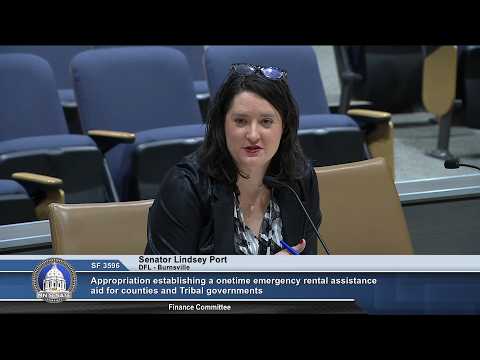
The Minnesota Senate Finance Committee on March 5 advanced Senate File 3596, a proposal to allocate $40 million from remaining funds tied to the Tyler settlement to emergency rental assistance for counties and tribal nations.
Sen. Port, the bill sponsor, told the committee the money is “remaining funds from the Tyler settlement” and described the proposal as a targeted way to help Minnesotans who are “struggling to afford their housing” after recent reductions in federal benefits and rising living costs. He said the funding is intended as a short-term lifeline disbursed through existing state programs rather than a new statewide emergency program.
Supporters cited sharp increases in demand at tenant services. Port said organizations such as Greater Twin Cities United Way, HomeLine and Legal Aid reported a 60–80% jump in calls for help and warned that counties have exhausted current quarterly rental assistance allotments. “This legislation would provide a 40 million dollar life boat as quickly as possible through a tested programs,” he said.
Committee members pressed for specifics about the funding source and the mechanics. Port summarized earlier legislative work on the Tyler settlement and said the legislature initially set aside about $109 million to resolve claims; later communications with the court-appointed administrator and the attorney general indicated roughly $35–45 million might revert to the state. The bill requires the administrator to return the lesser of $40 million or the amount not needed to settle outstanding claims to the state treasury for cancellation and re-appropriation.
Sen. Pratt and others questioned how the $40 million figure was chosen after earlier estimates ranged from $50 million to $75 million. Port said the estimate evolved as the sponsor’s office consulted counties and nonprofit partners, and used United Way 211 data that projected higher near-term need.
The committee also debated program design and safeguards. The bill routes aid through existing channels — primarily county administration and the Family Homelessness Prevention and Assistance Program (FHPAP) or accredited local housing agencies — so metro counties are likely to administer funds directly and many greater Minnesota counties will use existing accredited nonprofit or HRA partners. Port said the bill allows counties to verify eligibility against other benefits (SNAP, WIC) and contains strong reporting requirements. He told the committee the assistance will generally go to landlords through program guidelines to ensure rent gets paid, while eligibility checks aim to limit improper payments.
Opponents raised fraud and timing concerns, arguing that advance distribution risks misuse and that many tenants already evicted after the Aug. 31 cutoff may not be helped. One member described the funding mechanism as “unusual” and urged tighter timelines and stronger limits on who may administer funds. Supporters replied that the measure is revenue-neutral to the state general fund bottom line (it relies on settlement funds returning to the treasury) and called the aid an urgent intervention while the Legislature addresses broader policy choices.
An amendment offered by Sen. Jay Himes and accepted by the sponsor added a prohibition on retaining any portion of the funds for administrative costs; as read into the record, the amendment would insert language that “counties, tribal governments and entities that administer the program may not retain any portion of the funds received for administrative costs.” The committee approved that amendment by voice vote.
After further discussion, Sen. Port moved that Senate File 3596, as amended, be recommended passed. The motion prevailed by voice vote and the committee advanced the bill. No roll-call vote was recorded in committee minutes; the action was taken by voice vote.
What’s next: The bill was recommended passed out of committee and will proceed to further Senate floor consideration and committee workflow; the measure’s implementation details — distribution timing, the exact amount returned from the Tyler-related account, and county administration plans — will be clarified in subsequent steps.
Notes: The sponsor described program limits including a two-month cap on rent arrears and utilities for qualifying households whose financial hardship began after Aug. 31. The transcript records supporters’ and opponents’ concerns about fraud, the pace of distribution and whether the money best serves competing priorities.