Get Full Government Meeting Transcripts, Videos, & Alerts Forever!
Get email alerts on the Historic Policy topic
No spam. Unsubscribe anytime.
Palatka historic board debates stronger local ordinances and legal limits under recent state law
Summary
Palatka's Historic Preservation Board discussed convening a workshop to draft historic‑district ordinances and lamented a lack of enforcement authority; staff warned recent state legislation (referred to as SB180) may limit how restrictive new local rules can be.
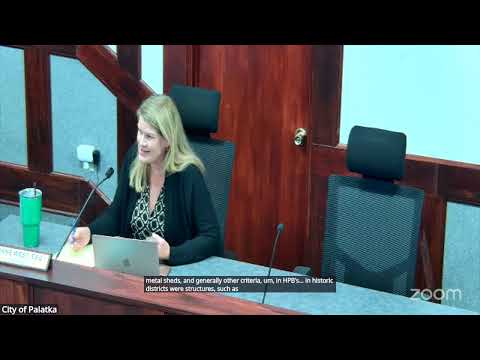
Board members at the March 5, 2026 Palatka Historic Preservation Board meeting spent an extended period discussing whether the board should pursue a workshop to draft enforceable historic‑district ordinances and how recent state law may limit local authority.
Several members, led by Miss Vote, said the board currently lacks enforcement 'teeth' to prevent incompatible features—examples cited included metal outbuildings and cars parked on porches. "We don't have any teeth," one member said, arguing the absence of enforceable local rules has hampered preservation. Board members urged reviving past programs, such as a tax‑increment finance (TIFF) home‑improvement program, to encourage maintenance and repair in historic neighborhoods.
Staff and other members cautioned that Florida legislation referenced in the meeting (identified in discussion as SB180) prevents local governments from adopting development regulations that are more restrictive than what existed before the statute. Staff said there may be limited avenues to regulate "contributing structures" that were listed on the National Register of Historic Places before 2000, but that the application of such provisions is narrow because not all district buildings are individually listed.
The board agreed to gather topics for a workshop and to email proposals to staff in advance; staff said it would prepare a white paper and noted the legislative session and pending lawsuits could change the environment. Mr. Romero agreed to circulate materials to absent members. The board discussed inviting code enforcement and planning staff for the workshop and suggested soliciting input from residents in the historic districts as the next step.
No formal ordinance was proposed at the meeting; the board directed staff to prepare follow‑up materials and a workshop agenda based on member submissions.