Get Full Government Meeting Transcripts, Videos, & Alerts Forever!
Get email alerts on the Facilities Policy topic
No spam. Unsubscribe anytime.
Board debates revisions to OE3 facilities policy, vendor criteria and project thresholds
Summary
At its March 2 work session the Racine Unified School Board reviewed proposed changes to OE3 (facilities oversight), including adding equipment to maintenance language, whether to require the superintendent to "develop and execute" facility plans, vendor-selection values (local/minority participation, apprenticeships, sustainability), and how to set project thresholds to avoid fragmentation. Staff will return with simplified, values-based language and procurement input.
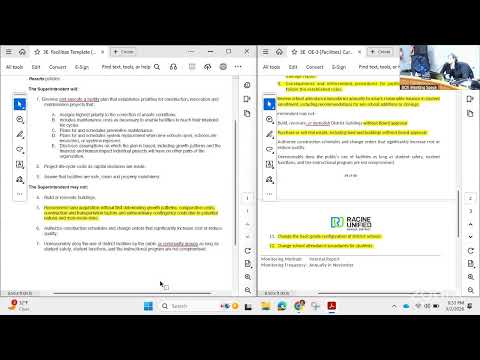
At a March 2 work session, the Racine Unified School Board spent the bulk of the meeting reviewing proposed revisions to OE3, the district's policy governing facility planning, maintenance and procurement.
Mr. Reynolds led a line-by-line comparison of the district's existing OE3 and an Aspen Group template, highlighting suggested changes such as adding the phrase "safe, efficiently used and properly maintained" to the opening sentence and requiring the superintendent to "develop and execute" a facility plan rather than only to develop one.
Board members on multiple occasions said they supported the principle of embedding procurement values '0including local and minority-contractor consideration, apprenticeship opportunities and sustainability 'but disagreed over how specifically to spell those values in the OE itself. Several members noted that purchasing already uses rubrics that score respondents on many of those criteria and urged staff to move detailed scoring or technical requirements into administrative regulations or indicators rather than the board's governing policy.
The draft also included a provision directing annual increases to the maintenance budget "until sufficient funds are budgeted." Members said the district's maintenance funding had improved and agreed to remove that automatic-increase language. They did, however, keep the broader expectation that maintenance funding and equipment be planned and budgeted.
Board discussion turned to a proposed monetary threshold (a $1 million reference in the draft) intended to prevent splitting large projects into multiple smaller procurements to avoid board review. Members noted the district currently requires board approval for projects over roughly $100,000 and asked procurement staff to advise how any new OE language would interact with existing thresholds and RFP practices.
On facility use and rental policy, staff said procedures and administrative rules already document most operational details; the board agreed to retain a succinct policy statement assuring that facility-use guidelines exist and to hold detailed criteria in administrative regs.
The board also added explicit language that changing basic grade configuration or attendance boundaries requires board approval, acknowledging that some of that requirement may already be specified in statute or administrative code.
Next steps: Miss Walker Cleveland agreed to draft a shorter, values-based version of the language ahead of the next work session; administration will return with proposed indicators/interpretations and input from purchasing on how procurement rubrics and dollar thresholds should be reflected in policy.