Get Full Government Meeting Transcripts, Videos, & Alerts Forever!
Get email alerts on the Municipal Budget topic
No spam. Unsubscribe anytime.
West Des Moines previews budget as 3.2% taxable growth triggers required levy reduction
Summary
At a workshop the council heard staff say taxable valuation grew about 3.2%, invoking a statutory requirement to reduce the general fund levy by 1% (roughly eight cents). Staff proposed offsetting that shortfall by adjusting the employee‑benefits levy and outlined next steps and filing deadlines.
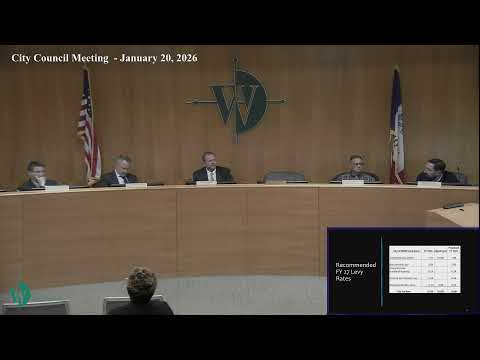
City staff presented a budget preview and a property‑tax briefing at a Jan. 20 workshop, telling the council that West Des Moines’ non‑TIF taxable valuation rose about 3.2% since the prior year — a rate that, under current state ratcheting rules, requires a 1% reduction in the general fund levy rate (about eight cents on the consolidated rate). Staff described options for preserving the city’s consolidated rate by shifting some capacity to other levies, such as increasing the employee benefits levy.
Presenter Tim summarized legislative changes and local factors: the residential rollback reduced taxable share to roughly 44% of assessed value, commercial backfill had been phased out, and county valuation filings (notably Madison County) could still affect final numbers. Tim said staff projected the eight‑cent reduction would bring the general‑fund levy to about 7.89 but that the city could increase the employee benefits levy to partially offset the impact. "We know that we have to come down 1%…we're going to have to come down roughly eight cents," one presenter said during the briefing.
Council members discussed reserves and timing. Staff reported the general fund reserve remained near 62% at the end of FY25 and emphasized flexibility in non‑general levies. Several members said they were reluctant to enact a tax cut this year given state legislative uncertainty and longer‑term pressures; others noted the city could always set the maximum and lower it later if conditions permitted.
Staff outlined the calendar for next steps: an additional budget workshop, a public hearing date to set the levy, and a March 5 deadline to file levy rates with the Department of Management so county mailers can be produced by the statutory notification dates. Staff also suggested inviting the local state delegation to the workshop so legislators can hear municipal budget concerns.
No final levy rate was adopted at the workshop; council members expressed support for continuing the process and directed staff to return with final figures and recommendations for the next council meeting.