Get Full Government Meeting Transcripts, Videos, & Alerts Forever!
Get email alerts on the Solar Development topic
No spam. Unsubscribe anytime.
TED Renewables outlines 900‑acre 'Horizon' solar plan; county residents press questions on siting, recycling and decommissioning
Summary
A TED Renewables representative described the Horizon Solar Project and said state and local rules (including a 2022 zoning amendment) now limit new large projects; residents asked about farmland use, panel toxicity and whether developers would fund decommissioning and local workforce training.
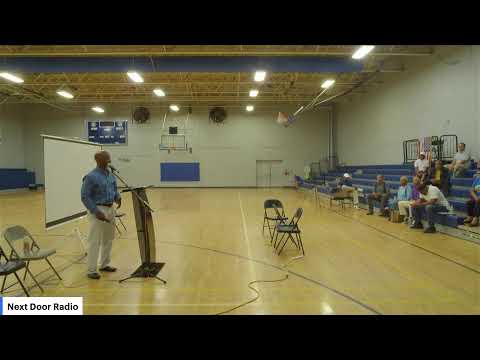
Dylan Stikney of TED Renewables presented the company's Horizon Solar Project and said the company has been engaged in Warren County for years. Stikney said about 10 existing local projects account for roughly 500 acres and that a 2022 amendment to the county zoning ordinance (as described at the meeting) added screening and a performance-bond requirement and capped most new projects at 150 acres, effectively preventing new large facilities unless the ordinance changes.
"If that ordinance does not change today or at some point in the near future," Stikney said, "you will not see another solar farm built in Warren County," adding that his Horizon proposal would total roughly 900 acres. He said existing local projects generated tax revenue and that he supports strict removal bonds and landscaping requirements.
Community members pressed TED Renewables and the Center for Energy Education on several points during an extended Q&A. Residents asked why developers target farmland rather than rooftops; Stikney answered that the region needs both rooftop and utility-scale generation and that North Carolina currently imports power at times. On manufacturing and workforce training, Ante Johnson of the Center for Energy Education described free local training, OSHA certification and a 3-day construction workshop planned for August.
An attendee asked about hazardous materials in panels. Stikney summarized panel components as "aluminum, glass, silicon wafers and a laminate back sheet," disputed a claim that arsenic is used and described recycling as an emerging industry. "A solar panel is recyclable 100%," he said, and pointed to research by the North Carolina Clean Energy Technology Center and a recycling facility in Salisbury. On decommissioning, Stikney said TED's lease agreements require removal of all equipment at the end of term and that the county ordinance and recent state legislation provide three layers of protection (contractual removal obligations, a county performance bond and state-level requirements) to prevent abandoned facilities.
Speakers and attendees also discussed aesthetic screening, distances between facilities and local tax benefits. Organizers and presenters invited residents to a Solar 101 workshop run by the Center for Energy Education and to a capped, free workforce training that the presenters said would be available to local residents.
No county decision was made at the town hall; TED Renewables and community groups offered further opportunities for questions and promised local workshops.