Get Full Government Meeting Transcripts, Videos, & Alerts Forever!
Get email alerts on the Data Centers Moratorium topic
No spam. Unsubscribe anytime.
Seattle committee previews one-year moratorium on new data-center land-use permits to study energy, water and community benefits
Summary
The Land-Use and Sustainability Committee heard public comments and a staff briefing May 11 on a proposed one-year moratorium on new data-center land-use applications to allow the city to define "data center," study energy and water impacts, and craft zoning and community-benefit standards.
Chair Eddie Lin opened the May 11 Land-Use and Sustainability Committee briefing and said the committee is considering a one-year land-use moratorium to buy time to develop definitions, standards and a workplan for data centers in Seattle.
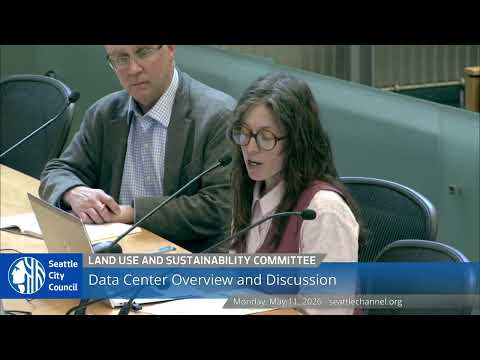
"There is currently no definition of data centers that is a working definition for the city," said Eric McConaughey of Council central staff, describing a range of facilities that can be "stacked, sprawling, large or small" and that vary by whether they are primarily storage or active computing, which affects equipment and infrastructure needs.
The committee heard two public comments. Peter, who said he works for a local real estate firm, urged caution about a blanket ban and proposed targeted limits such as megawatt caps and colocating data-center floors with office uses so the city can retain jobs. "There is an opportunity to set limits on the amount of power consumption, a megawatt limit," Peter said, adding that outright bans could push development just outside Seattle’s borders and cost the city jobs.
Dan Deora, vice president of state policy for the Data Center Coalition, emphasized economic contributions and called digital infrastructure "the backbone of the 21st century economy." Deora urged the committee not to adopt a moratorium that would prematurely block development, noting data centers support construction and skilled-trade jobs and arguing for more study of broader economic impacts.
Central staff and several councilmembers said the moratorium is intended to pause acceptance of new land-use applications while the city researches definitions, permitting history, and thresholds and develops zoning standards, monitoring approaches for electricity and water use, and options for community benefits. Staff described the draft moratorium as immediate in effect but not retroactive to applications already under review.
Councilmember Juarez pointed to recent legislation in other jurisdictions and asked whether community benefits agreements and worker protections could be part of the city’s approach. "How would it look — making data center investments for people?" Juarez asked, noting a New York law referenced in briefing materials.
Councilmember Kettle and Council President Hollingsworth urged thorough due diligence and close coordination with Seattle City Light and Seattle Public Utilities given concerns about outages, grid strain and water usage. Hollingsworth noted examples cited elsewhere of severe community impacts and said Seattle’s regulation should be deliberate to avoid unintended harm while preserving economic opportunity.
Staff said additional research is required to determine how many data centers currently operate in Seattle, how they were permitted under existing land-use categories, and whether the city has provided incentives tied to these facilities. Staff also noted the city’s land-use moratorium authority is understood to apply within the city’s geographic limits, while utility-rate and service-area issues may extend beyond city boundaries and require regional coordination.
Committee members discussed setting threshold triggers (for example, megawatt levels) and emphasized that the moratorium’s initial definitions might be provisional and refined through the workplan. Chair Lin said the moratorium is meant to establish a policy foundation for later legislation and that more research and a proposed ordinance will follow.
The committee did not take any formal vote on the moratorium at the May 11 briefing; Chair Lin adjourned the meeting at 2:49 p.m. The staff briefing and a draft resolution are expected to be circulated to councilmembers in the coming days for further review.