Get Full Government Meeting Transcripts, Videos, & Alerts Forever!
Get email alerts on the Ecology Water Quality topic
No spam. Unsubscribe anytime.
Committee flags sediment, oxygen dynamics and water chestnut as primary issues at Warner's Pond
Summary
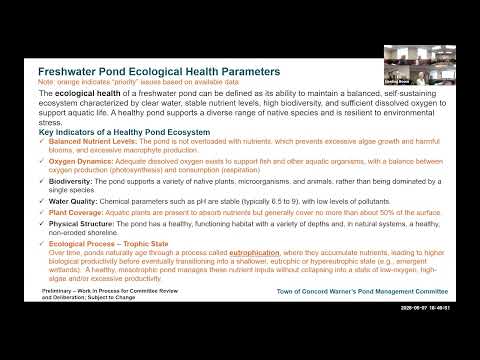
Committee members identified internal sediment nutrient loads, oxygen stratification in deeper pockets, and high biomass of invasive water chestnut as the primary ecological concerns for Warner's Pond. They emphasized using existing data and targeted monitoring to shape mitigation plans.
Committee members reviewed decades of data and highlighted three primary ecological concerns for Warner's Pond: sediment-bound nutrient stores, low oxygen in deep pools, and extensive vegetation dominated in parts by the invasive water chestnut.
Dan, who presented the conceptual model and data summary, told the committee the available records include sediment probing, water-quality sampling and plant-coverage surveys spanning from the late 1990s to sampling as recently as 2024: "we've had a series of water quality sampling... spanning from the late 1990s to... 2024," he said. Dan said sediment sampling shows "very high total organic compounds" in the pond's sediment and described sediment as a major internal nutrient source that can re-release nutrients to the water column.
On oxygen dynamics, committee members noted limited time-series data but pointed to existing top-bottom sampling that shows stratification and depleted bottom-layer oxygen in places. They said these low-oxygen deep pockets may not fully overturn each season and can drive decay and internal nutrient cycling.
Vegetation coverage was widely discussed. Dan described high coverage and biomass in large pond areas and identified water chestnut as "a pretty... aggressive species" that contributes to ecological imbalance. The committee emphasized that the goal is not total vegetation removal; Dan suggested a habitat target closer to about 50% coverage depending on the pond location to balance wildlife habitat and recreation.
Members agreed that additional targeted monitoring (April-May baseline sampling) and updated fish and wildlife inventories should be part of the consultant's scope to clarify spatial variation in oxygen, nutrient flux and vegetation. They also noted localized algal blooms have been observed (committee members referenced a 2025 bloom) and said management decisions should be informed by both historical reports and up-to-date monitoring.