Get Full Government Meeting Transcripts, Videos, & Alerts Forever!
Get email alerts on the Public Safety topic
No spam. Unsubscribe anytime.
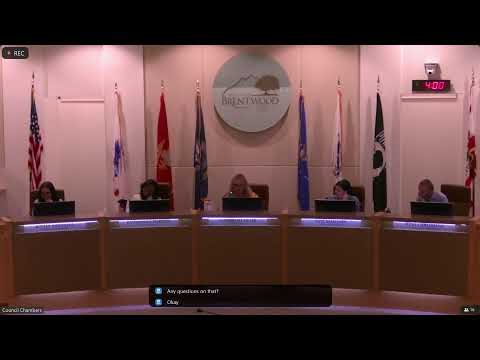
Brentwood Council advances 'unlawful or unruly gatherings' ordinance after heated debate
Summary
After hours of public comment and council debate about enforcement, civil liberties and impacts on homeless residents, Brentwood City Council introduced and waived first reading of a new administrative ordinance that allows expedited citations for nuisance behaviors and a $100/$200/$500 fine schedule.
Brentwood — The City Council voted May 12 to introduce an ordinance creating a new administrative tool to address persistent nuisance behavior at private properties, including loud parties, fireworks, repeated police calls and other conduct the city says degrades neighborhood quality of life.
Councilmember FA Maloney, who led the effort, said the measure was designed to help neighbors and police when criminal prosecution or district-attorney charging is not available: “When police do their job and arrests are made but incidents continue, we need an administrative tool to hold property owners accountable,” Maloney said.
The ordinance (chapter 8.39 of the Brentwood Municipal Code) allows the city to issue an administrative warning on first contact and an escalating fine schedule — $100 for a second violation, $200 for the second, $500 for subsequent violations within 12 months — and permits third-party submissions of credible evidence when officers cannot witness behavior directly. It also includes an explicit carve-out saying calls related to domestic violence are not treated as social-nuisance violations.
Vice Mayor Pearson and other council members pressed staff and the city attorney on definitions and scope, arguing the draft left too much enforcement discretion and risked chilling protected speech or being applied unevenly. “When you don’t define ‘loud’ or ‘unruly,’ you leave too much to the enforcer’s judgment,” Pearson said, urging clearer standards tied to existing state law definitions of public nuisance (Cal. Civ. Code §3480).
City Attorney Thomas Lloyd Smith and staff told council they can tighten definitions but warned that overly technical limits (for example, codifying an exact decibel threshold) can create enforcement burdens—such as requiring decibel meters at every response—that make the ordinance difficult to implement. Police Chief Walter O’Rnik said the tool is meant to complement, not replace, existing criminal enforcement and would be used alongside police reports and evidence collected during investigations.
Public commenters sharply divided the meeting: some residents described years of repeated, disruptive criminal activity at particular addresses and urged an administrative remedy; others — including civil-liberties advocates and residents wary of enforcement discretion — warned the ordinance could be misused and urged tighter language and procedural safeguards.
Councilmember Maloney moved to introduce and waive first reading of the ordinance after amending the title to “Unlawful or Unruly Gatherings” and adding a definition referencing Civil Code section 3480. The motion passed with one recorded opposition.
Next steps: staff will incorporate council direction on clarified definitions and the civil-code reference and return the ordinance for second reading and adoption. The council also directed staff to work with the police department and community-enrichment staff on enforcement protocols, documentation standards and landlord accountability measures.