Get Full Government Meeting Transcripts, Videos, & Alerts Forever!
Get email alerts on the Mental Health Services topic
No spam. Unsubscribe anytime.
Mobile crisis director outlines 24/7 emergency response, announces larger Chelsea site
Summary
At a Chelsea Chamber event, Lisa Berton of North Suffach’s Mobile Crisis described the program’s 24/7, insurance‑blind emergency mental‑health response, explained referral and safety rules, and said the team signed a long‑term lease for a larger Chelsea location expected to open in July.
Lisa Berton, director for Mobile Crisis with North Suffach, told a Chelsea audience the team provides a 24/7, insurance‑blind mobile mental‑health response that goes to schools, homes, police stations and shelters to evaluate people in psychiatric crisis.
"We are a 24/7 ... mobile mental health who go out into the community ... we're insurance blind and we see all ages," Berton said, explaining the program responds to callers with crises ranging from suicidal thoughts and psychosis to severe behavioral dysregulation in children.
Berton outlined how the service works: callers reach a hotline where triage staff collect demographic and clinical information, a local clinician is assigned, clinicians consult supervisors and physicians as needed, and staff consider dispositions that range from outpatient referral to urgent psychiatric admission. She said a separate youth team follows clients 20 and under for up to seven days, extendable if necessary, to coordinate care and adjust plans.
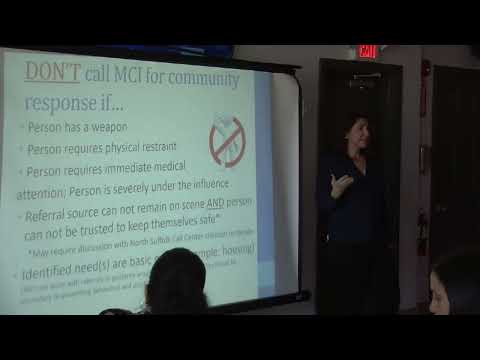
Berton emphasized limits on the mobile response: "Please don't call us if this person has a weapon. Uh, we are not police," she said, adding that teams do not perform physical restraints and will call 911 or ask police to accompany clinicians when triage indicates imminent danger.
The director also described operational constraints: clinicians typically respond alone and follow traffic laws, the program strives for an hour-from-ready-to-evaluation metric but can be delayed by staffing and Boston‑area traffic, and staff use an alert system to summon emergency assistance if a visit turns unsafe.
On language access and capacity, Berton said the team includes Spanish‑ and Portuguese‑speaking clinicians and uses staggered shifts, telehealth and manager telehealth evaluations during high call volume.
A program representative announced the team has signed a long‑term lease for a new Chelsea site currently being built at “517” (street name not specified in the presentation) and expects to move there in July; organizers said the new space will roughly double the program’s current capacity.
Organizers left hotline business cards on the tables and said presentations and materials will be posted to the event website.
Details at a glance: hotline triage, master‑level clinicians, family partners and recovery coaches, youth follow‑up for seven days, multilingual clinicians, and the new Chelsea site expected to open in July.