Get Full Government Meeting Transcripts, Videos, & Alerts Forever!
Get email alerts on the Lgbtq History Pride topic
No spam. Unsubscribe anytime.
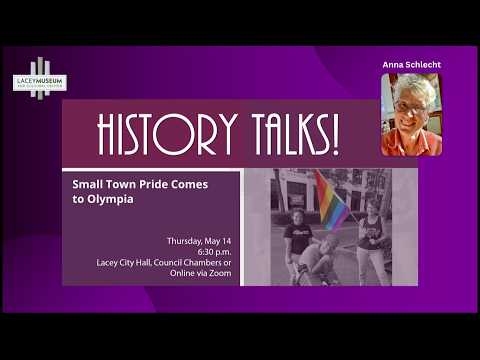
Anna Schlecht traces origins of Capital City Pride, urges online archive to preserve local LGBTQ history
Summary
At a Lacey History Museum talk, Anna Schlecht, a cofounder of Capital City Pride, recounted the festival’s early days in Olympia, described tensions over sponsorship and inclusion, donated her honorarium to Capital City Pride and proposed creating an online LGBTQ history museum to preserve organizers’ records.
At a Lacey History Museum program, Anna Schlecht, cofounder of Capital City Pride, recounted how a handful of local organizers in the early 1990s turned carpools to larger cities into a homegrown Pride parade in Olympia and urged the preservation of local LGBTQ materials through a proposed online history museum.
Schlecht framed the talk by placing Olympia’s Pride in the arc of national LGBTQ activism. “We stand on the shoulders of people who came before us,” she said, describing early protests, the 1966 Compton Cafeteria resistance and the 1969 Stonewall uprising as precursors to the parades and festivals that followed.
The talk moved from large-scale context to local detail: organizers held three founding meetings before deciding to stage a parade in Olympia, borrowing a phone from a local gay resource center to organize and relying on carpools and flyers to bring people in. Schlecht said early participants risked jobs and family relationships to attend: many wore sunglasses at marches “because they were terrified they were going to lose their job.” She credited local volunteers and photographers—naming Todd Streeter and Kelly Hawke among those who helped document the early events—for preserving what now survives of those first years.
Schlecht described how the festival evolved into a family-friendly event that also sought to pay performers and workers. “It was really important to me to make sure that people that did labor were paid for their labor,” she said, explaining why organizers accepted sponsorships from local businesses and, at times, alcohol-industry donors to cover costs. That approach prompted debate: Schlecht acknowledged critics who opposed taking money from certain corporate or alcohol sponsors and said organizers wrestled with the trade-offs between revenue and community values.
The presentation also addressed sharp moments in Pride’s recent history. Schlecht said the parade’s 25th anniversary coincided with the national trauma of the Orlando massacre, and that the aftermath exposed deeper divisions in the local community about whether Pride should emphasize protest or celebration. She described how those tensions “fractured our pride committee” and prompted ongoing conversations about race, politics and generational differences in aims and tactics.
Audience members and virtual participants added memories and questions during a lengthy discussion. One commenter recalled early state employees covering their faces to avoid recognition in a parade; another asked about local rallies held after an assault on community member Bill Clayton, which Schlecht said the community responded to as a crisis that revealed how “hate turns into violence and can kill.”
Near the close of the program, Schlecht announced she was donating her honorarium from the museum event to Capital City Pride. She also urged a new effort to collect and preserve local LGBTQ artifacts, saying, “I would like to create an online LGBTQ history museum,” and adding that she wanted to move items currently stored in her basement into a digital collection before they were lost.
Felicia Rova Cameron, the museum’s associate curator, opened the evening with a land acknowledgment for the Treaty of Medicine Creek tribal peoples and shared information about upcoming museum events, including a grand-opening celebration planned for June.
Schlecht and participants emphasized both the festival’s gains—greater visibility, youth involvement and expanded partnerships—and its unresolved struggles, particularly around inclusion of transgender people and racial equity within the movement. She urged continued coalition work, saying community organizing inevitably involves conflict and that those tensions are part of building enduring local institutions.
The museum program concluded with organizers and attendees planning a reunion of early Pride organizers and with Schlecht’s call for volunteers and support to build a publicly accessible historical record of the region’s LGBTQ activism.