Get Full Government Meeting Transcripts, Videos, & Alerts Forever!
Get email alerts on the Future Ready Plan topic
No spam. Unsubscribe anytime.
Hundreds urge Pittsburgh school board to delay vote on "Future Ready" reconfiguration plan
Summary
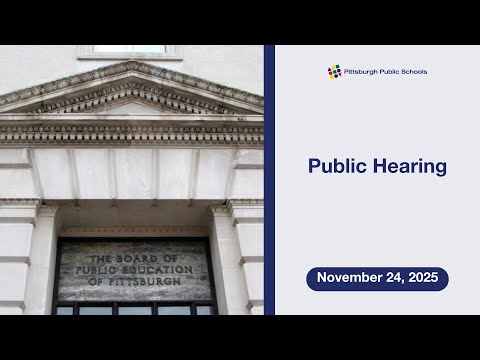
At a Nov. 24 public hearing, more than a hundred commenters pressed the Pittsburgh Board of Public Education to delay or reject a district facilities "Future Ready" plan, citing missing data, threats to neighborhood schools and disproportionate impacts on Black students and those with disabilities. The board is scheduled to vote Nov. 25.
Hundreds of parents, students, teachers and community members told the Pittsburgh Board of Public Education on Nov. 24 that the district's "Future Ready" facilities and reconfiguration plan is incomplete and dangerous to neighborhood schools.
Speakers at the two-hour-plus public hearing repeatedly asked the board to postpone a scheduled vote set for Nov. 25 at 6:30 p.m., saying the administration has not produced essential details about enrollment projections, transportation, staffing, special-education procedures or the timeline for renovations and relocations.
The hearing opened with moderator Erica Gandandy reviewing speaker rules. The first public commenter, Michelle Bole, called schools "our children's second home," urging the board to "stop evicting our children from their second home." Robbie Ali, a retired physician and longtime volunteer at Liberty School, told the board he was "asking that current third and fourth graders at Liberty School be allowed to finish there and graduate the fifth grade," and urged more time for community input.
Multiple parents and students described specific local harms. Cara Bratannic and others argued that moving the Monastery (Friendship) program to Lynon would sacrifice a highly walkable neighborhood site, disrupt community partners and risk enrollment losses. Several parents said they had been presented with final-looking files but without the attendance-zone maps, reliable enrollment forecasts or transportation plans they need to make decisions about next year.
Advocates and equity leaders raised legal and procedural questions. Wanda Henderson, chair of the Equity Advisory Panel, said the panel was not consulted in drafting the plan despite the panel's role under a prior MOU. Rachel Shalots read a legal opinion from the district solicitor advising that reassigning students with disabilities could require IEP revisions and BSE review; she said that advice conflicts with the district's FAQ page and urged the board to reconcile the difference before approving changes.
Speakers also pressed the administration on the plan's claimed equity benefits. Valerie Webb Amed presented district-displacement numbers she said show disparate impacts: she said Black students represent 49% of enrollment but 55% of those slated to be displaced, while English learners and homeless/transient students are also over-represented among those who would move.
Financial and operational concerns were a through-line. Michael Cummings suggested the district could realize savings from cyber-charter reforms (cited by him as $8.4 million) and procurement changes (he cited $10'$16 million) to avoid rushed closures. Others questioned $30 million estimates tied to reopening particular campuses and asked how projected renovation funding would be secured before students are moved.
Labor leaders offered a mixed view. Billy Hileman, president of the Pittsburgh Federation of Teachers, acknowledged the need to right-size the district but said the scale, complexity and aggressive timeline make the plan risky. He recommended careful attention to staffing and class-size impacts if the board advances any reconfiguration.
Throughout the hearing parents, students and community groups proposed alternatives: phased pilots rather than mass relocations, clearer academic models for receiving schools, binding timelines for construction and renovations, and an enforceable community safety net to protect students with the highest needs.
The hearing closed after the board's moderators called absent registrants and reminded listeners that the board's legislative session was scheduled for Nov. 25 at 6:30 p.m., when members are expected to consider the implementation resolution.
What happens next: The board is scheduled to vote at the legislative meeting tomorrow evening. Testimony at the hearing leaves clear fault lines: many community members urged delay and revision, district leaders have argued that facilities and finances require bold action, and advocates flagged unresolved legal and programmatic questions about special-education placements, transportation and equity.
Speakers quoted in this article appear in the public hearing transcript filed by the district.