Get Full Government Meeting Transcripts, Videos, & Alerts Forever!
Get email alerts on the Holiday Drive Shelter topic
No spam. Unsubscribe anytime.
Charlottesville leaders press for Holiday Drive operating plan and a project manager amid funding questions
Summary
City staff and homeless‑service providers agreed to produce an operational plan, re‑engage the architect and identify a project manager for Holiday Drive after the city’s $6.2 million property purchase, while acknowledging uncertainty about raising the funds needed for construction and operations.
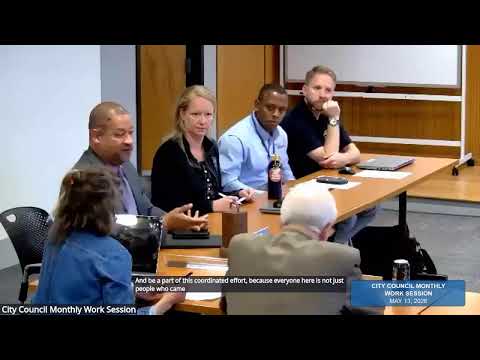
City staff and local homelessness providers used a May 13 special council work session to map next steps for an ambitious plan to convert 2000 Holiday Drive into a low‑barrier shelter and service hub, but stopped short of any votes.
Natalie, the city staff member who led the session, said the city purchased the Holiday Drive property for $6,200,000 and that “that was as far as we could go” on the acquisition without additional fundraising. She urged clearer operational budgeting before the city could make commitments on ongoing costs.
Providers representing the Continuum of Care asked council to: vote on a design option presented March 25 or set new design parameters; authorize an interim use review by the building official so providers could occupy the space; and help identify a project manager to coordinate design, procurement and operations. “We would love for city council to vote on the design options,” one COC representative said, noting a desire for clarity on what the city would be asked to contribute toward operations.
Councilors and providers discussed design tradeoffs and cost reductions, including removing a small clinic addition in favor of a UVA mobile clinic. Providers warned that eliminating the addition could reduce bed counts by roughly 8–10 beds — “bring it from 80 to 70 to 72 beds,” a provider noted — and that the elevator in the addition was a critical accessibility and safety element.
On timelines, participants agreed to re‑engage the architect to quickly test narrower design parameters and to produce an operational plan and detailed budget. Several participants asked for a fast turnaround; the COC and city staff discussed a three‑month target and one participant proposed an August 31 deliverable for an operational plan. Natalie agreed the city would designate a project management connection and committed to regular brief updates to council.
City staff emphasized the difference between capital and operations: the city had purchased the facility but partners would need to raise philanthropic and other funds to complete fit‑out and support operations. Natalie also noted parallel fundraising by the Salvation Army and uncertain state budget outcomes that could affect available support.
No formal council vote was taken at the work session. Attendees agreed on next steps — re‑scoping the design, presenting a clearer operating budget, pursuing an interim building‑code review and identifying a funded project manager — and set follow‑up meetings to produce deliverables.
The council wrapped the session without policy votes; staff said they would report progress to council in short updates at future meetings.