Get Full Government Meeting Transcripts, Videos, & Alerts Forever!
Get email alerts on the Hillside Drive Safety topic
No spam. Unsubscribe anytime.
Burlingame commission weighs stop signs, radar signs and quick‑build changes to calm Hillside Drive
Summary
Residents pressed Burlingame’s Traffic Safety and Parking Commission to act after repeated near‑misses and crashes along Hillside Drive; staff recommended a formal speed survey and stop‑sign warrant process while commissioners signaled support for quicker paint‑and‑beacon measures pending study results.
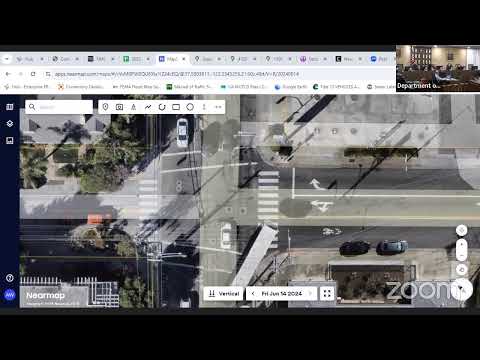
The Burlingame Traffic Safety and Parking Commission heard hours of public testimony Oct. 10 on safety problems along Hillside Drive, a residential corridor used by students walking to nearby schools. Staff recommended an engineering speed survey and a stop‑sign warrant evaluation while flagging short‑term, low‑cost measures that could be implemented sooner.
Traffic engineer Mr. Wong told the commission the subcommittee’s recommendations for the stretch between Alvarado and El Camino include: explore reducing the posted speed from 30 to 25 mph through the city’s engineering speed survey; evaluate adding a stop control near Castillo or Carlos to create a midpoint; deploy mobile/radar speed‑feedback signs; and defer speed cushions because Hillside functions as a minor arterial and emergency access route. “If we can reduce the speed limits using that process we will try,” Wong said, noting the city must follow established criteria in the California Vehicle Code when setting speeds.
Why it matters: residents said children regularly walk and bike across the corridor at school drop‑off times and that sight lines and a long downhill segment invite speeding. Samantha French, whose child is hearing‑impaired, urged a study of Vancouver and Adeline and asked the commission to consider physical calming measures that would make crossings safer for children. “There are 22 children that live on the 1500 block of Vancouver alone who often cross Adeline right there,” she said, and asked the city to put the intersection on a future agenda for focused study.
Public testimony was extensive and mixed. Several speakers urged immediate, visible action — more stop signs, crosswalks with rapid‑flashing beacons, painted edge lines, pedestrian refuge islands and periodic police enforcement during school hours. Other residents warned that too many stop signs could be ignored and push traffic onto nearby side streets, and they urged better enforcement of existing controls before adding new ones. One resident asked that the forthcoming traffic study also identify whether problem drivers are local or passing through, to guide whether enforcement or physical changes are the right remedy.
Commissioners generally favored a two‑track approach: continue the formal engineering process (a speed survey expected before the end of the year and stop‑sign warrant reviews) while pursuing quick‑build visual changes and deployable tools. Commissioner Couchi recommended adding pedestrian counts and school‑time observations to the study; Commissioner Israelit and others expressed concern that the state’s speed‑setting criteria constrain local arbitrary speed reductions, so staff should pursue Vision Zero tools if the survey does not permit a lower posted speed. Several commissioners recommended quick‑build options — painted edge lines to visually narrow the roadway, bulb‑outs at intersections, rapid‑flashing beacons at a midpoint such as Castillo, and rotating radar trailers that provide driver feedback.
The commission did not take a final vote on permanent treatments. Staff said they would work with the Hillside subcommittee to refine recommendations, incorporate the public input received in person and by email, and return with a focused implementation plan that balances engineering warrants, budget constraints and neighborhood impacts. Mr. Wong said the speed study is being processed now and staff will share the results with the commission once available.
Next procedural step: staff will complete the speed survey and stop‑sign warrant work, add pedestrian counts and routing analysis as requested, and return with a prioritized set of measures for the commission to consider. The commission also encouraged staff to pursue low‑cost, quick‑build measures that do not require lengthy engineering design while the formal studies proceed.
Sources: public testimony and staff presentation at the Oct. 10, 2024 Traffic Safety and Parking Commission meeting.