Get Full Government Meeting Transcripts, Videos, & Alerts Forever!
Get email alerts on the Accessibility Policy topic
No spam. Unsubscribe anytime.
Committee advances bill to codify ADA protections, require agency accessibility plans
Summary
Baltimore City Council committee voted to report favorably on Council Bill 25‑0126, which would codify Title II ADA standards into local law, require agency accessibility plans and ADA coordinators, create grievance procedures, and make the city’s digital systems immediately subject to accessibility rules; the bill moves to second reader April 22.
Baltimore City’s Committee on Legislative Oversight voted to give a favorable report to Council Bill 25‑0126, an amended ordinance that would codify Title II of the Americans with Disabilities Act and require every city agency to adopt accessibility plans, designate an ADA coordinator and implement grievance and reporting procedures. The committee approved the sponsor’s amendments and moved the bill to second reader on April 22.
The bill, sponsored by Councilwoman Odet Ramos (14th District), replaces the original text with an amended version that inserts federal ADA language and clarifies definitions, including the distinction between "reasonable accommodation" (employment‑related adjustments) and "reasonable modification" (changes to policies, practices or procedures). Ramos said the measure also requires agencies to develop digital‑access policies and that the bill spells out auxiliary aids and services — such as qualified interpreters, captioning, braille and assistive technologies — and a duty to provide effective communication when requested.
"We want to be thoughtful and strategic about implementation as well as go beyond the call of duty to make sure that we’re providing the services that everyone in our community deserves," Councilwoman Ramos said during opening remarks, urging a favorable report so the digital provisions could be scheduled promptly. Ramos and the law department clarified during questioning that the April 25 compliance date discussed in the hearing is cited in the law department’s bill report and is not text contained in the ordinance itself; the amended ordinance carves out the digital access section for immediate implementation while phasing other requirements over a year.
Public testimony at the hearing included multiple disability‑rights advocates and residents who urged passage. Jacob Leter, who introduced himself as president of the Baltimore City Association for the Deaf, said the bill would reduce barriers to interpreting and captioning and called equal access a civil right. "This bill will help deaf and hard‑of‑hearing individuals not feel marginalized or excluded," Leter told the committee. Deanna Tilden and other witnesses described frequent barriers to participation — inconsistent provision of interpreters and reliance on auto‑captions — and urged the committee to adopt the amendments.
Agency testimony supported the measure but flagged implementation details and costs. Desiree Lucky of the Law Department said the office found the amended bill "form and legal sufficiency" and reiterated the need to prioritize the digital access section because of federal obligations. A Finance Department representative said the bill "does not oppose" but estimated a fiscal impact of at least $318,500 to fund anticipated staffing needs in the Office of Equity and Civil Rights (OECR) to develop, support and oversee agency accessibility plans; Finance also noted $30,000 is included in the fiscal 2026 budget for closed‑captioning costs (the $60,000 figure cited earlier in the hearing was corrected to $30,000).
OECR staff described how the office would operationalize the ordinance, including training for ADA coordinators, technical support for agency plans, and centralized reporting. Zachary Wellman, equity policy analyst, said the bill would "go beyond the minimum requirements of the ADA" by requiring agency‑specific accessibility plans and public reporting on accommodations and grievances. OECR described a staged implementation approach and said that some elements — especially front‑facing digital services and emergency communications — would be prioritized.
Committee members pressed agencies on several points during questioning: how the city will align Title II (public programs and services) with Title I (employment) where necessary, how the Department of Human Resources will be involved when accommodations relate to hiring or employee records, how OECR will balance oversight with privacy protections, and how Charm TV/BIT and other city media will meet digital accessibility obligations. Isaiah Griffith of the Mayor’s Office offered to follow up with BIT/Charm TV to provide a compliance timeline for the committee.
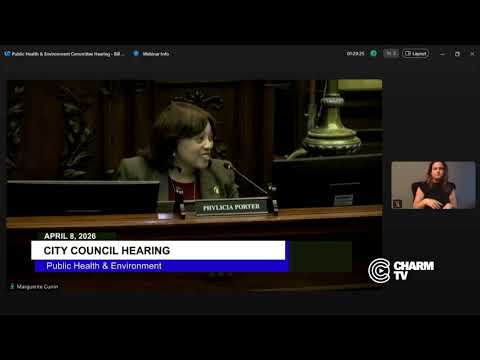
The committee also requested a list of each agency’s designated ADA coordinator (including City Council) and asked the mayor’s office to provide that roster within a week. In committee votes, Councilwoman Felicia Porter (chair), Mark Parker, Ryan Dorsy, James Torrance and Odet Ramos were recorded as voting in favor; the motion passed and the bill was advanced with the sponsor’s amendment. The committee clerk announced the bill will be second reader at the full council meeting on April 22 and double read at that meeting.
What’s next: The committee will monitor implementation planning over the year the ordinance allows agencies to prepare their plans; OECR and the mayor’s office will report back as agencies develop their accessibility plans, training and reporting protocols. The committee’s immediate follow‑ups include the requested ADA‑coordinator list and a clarification from BIT/Charm TV on digital‑access readiness.
Sources: Committee hearing on Council Bill 25‑0126 (introduction, sponsor remarks, public testimony, agency reports, questioning and votes).