Get Full Government Meeting Transcripts, Videos, & Alerts Forever!
Get email alerts on the Tax Assessment Policy topic
No spam. Unsubscribe anytime.
Committee debates tax-assessment policy thresholds and effective date before moving policy to full board
Summary
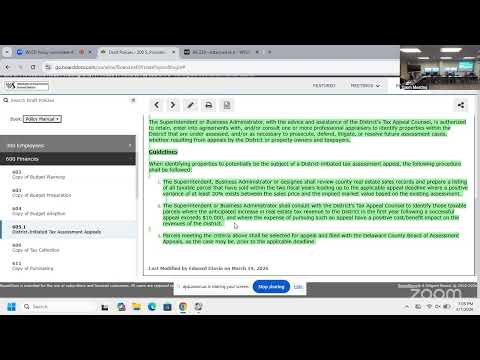
Policy 605.1 would authorize the district to identify potentially underassessed properties for appeals; committee members questioned a proposed 20% variance and $10,000 revenue threshold and pressed staff to set a clear effective date so the policy is not applied retroactively to existing homeowners.
The committee considered a new Policy 605.1 that would let the district identify and, where appropriate, pursue appeals on underassessed properties. Staff described the policy as a nondiscriminatory process that typically relies on sales data, appraisals and a cost‑benefit test before filing an appeal.
Committee members focused on three main issues: (1) the objective identification criteria (a proposed 20% assessment variance), (2) a proposed threshold that an appeal should generate at least $10,000 of additional annual tax revenue to justify the expense, and (3) whether the district should limit reviews to sales after a specified effective date to avoid retroactively imposing appeals on current homeowners. Some members said a $10,000 cutoff may be too high for a largely residential district and urged lower thresholds or an explicit nonretroactivity clause.
Staff explained the policy is intended to look primarily at property sales (so it is triggered when a home changes hands and a sale price exists) and suggested the committee could set a start date so only sales after the effective date are eligible. Staff also noted that administrative discretion may be needed to avoid pursuing marginal cases that would cost more to litigate than the expected revenue.
The committee agreed to move the policy to the full board with two clarifications requested: (a) staff will confirm language about the effective date/cycle (for example, whether reviews will cover only sales after adoption), and (b) staff will reassess the revenue threshold and related cost‑benefit phrasing. Those clarifications will be incorporated before the item returns to the board.