Get Full Government Meeting Transcripts, Videos, & Alerts Forever!
Get email alerts on the Environment And Agriculture topic
No spam. Unsubscribe anytime.
Seneca Conservation District says it educates and refers, not enforces, on manure and permitted farms
Summary
Morgan Mitzer, district administrator at the Seneca Conservation District, told county commissioners the district provides outreach, technical assistance and referrals under a memorandum with the Ohio Department of Agriculture but does not hold regulatory authority to monitor permitted livestock or poultry facilities; she invited the public to a local workgroup meeting.
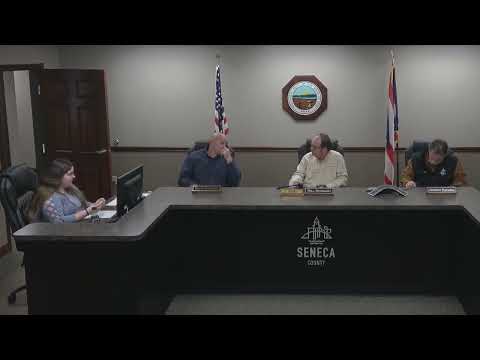
Morgan Mitzer, district administrator at the Seneca Conservation District, told the Seneca County Board of Commissioners on April 7 that the district’s role is education, technical assistance and referral, not regulatory enforcement of permitted livestock and poultry operations.
Mitzer said a recent public statement that implied the local soil and water district “monitors” Seneca Poultry LLC was inaccurate and required correction. She explained that the Ohio Department of Agriculture’s Division of Livestock Environmental Permitting (DULP) — cited variously in the meeting transcript as the agency with permitting and regulatory authority — handles construction and operation oversight for large livestock and poultry facilities in Ohio. “ODA has the legal authority. We’re a helping hand,” Mitzer said, describing the district’s work as connecting landowners, producers and the public with the appropriate state program specialists.
She reviewed the district’s memorandum of understanding with ODA to implement Ohio’s Agricultural Pollution Abatement Program (APAP) locally, saying the district provides program information, technical assistance, and guidance to help producers meet APAP rules and standards. Mitzer emphasized that the district receives many public inquiries — about flies, manure, water access and culvert sizing, among other topics — and that staff triage calls and direct callers to the correct local, state or federal agency.
Mitzer described the complaint process she follows: staff research a reported complaint, identify landowners and producers, and escalate matters that concern permitted facilities to ODA’s program specialists and DULP. She said the district does not proactively patrol or scout farms for compliance issues and that involving the U.S. EPA typically occurs later in the jurisdictional flow and can carry immediate cost consequences for landowners. “We do not monitor. We do not patrol. We are not the manure police,” she told the board.
Mitzer invited commissioners and the public to a local workgroup meeting the next evening (6–8 p.m., service center conference room) with presentations from Mitzer, the Farm Service Agency, the Natural Resources Conservation Service and OSU Extension to explain roles, answer questions and share technical information.
Board members also asked Mitzer about data centers and potential water‑use impacts. Mitzer said she had reached out to ODA for statewide guidance and noted the legislature’s study on data centers would help shape local responses; commissioners said they had not received a formal proposal for a data center in Tiffin at the time of the meeting.
The presentation aimed to clarify jurisdictional lines, correct inaccurate public statements about local monitoring authority, and provide a local forum for information and questions about manure management and agricultural permitting.