Get Full Government Meeting Transcripts, Videos, & Alerts Forever!
Get email alerts on the Franchise And Excise Tax topic
No spam. Unsubscribe anytime.
Tennessee Department of Revenue explains franchise and excise tax exemptions for farming and personal residences held in LLCs and partnerships
Summary
Meagan Choate of the Tennessee Department of Revenue outlined which limited liability entities qualify for franchise and excise tax exemptions for farming and owner-occupied residences, the ownership and activity tests, filing forms (FAE 183 and FAE 170), deadlines and a $200 late-filing penalty.
Meagan Choate, Taxpayer Services Division, Tennessee Department of Revenue, presented a webinar detailing eligibility rules and filing requirements for franchise and excise tax exemptions when farming or owner-occupied residences are held in certain business entities.
Choate said qualifying entities include limited liability companies, limited partnerships and limited liability partnerships, and that at least two-thirds of an entity’s activity must be farming or holding one or more personal residences (including contiguous acreage used with the dwelling) to be eligible. She cited Tennessee Code Annotated section 67-4-2008 and Internal Revenue Code section 280A as the controlling authorities for these rules.
The department set an ownership threshold to limit eligibility: at least 95% of voting rights, capital interest or profits must be owned by natural persons who are relatives of one another or by a trust for their benefit. Choate read the statutory definition of "relative," which covers persons descended from a common ancestor closer than a first cousin and spouses of such relatives.
Choate listed qualifying farming activities that meet the statute’s test: growing crops, nursery products, timber and fibers (such as cotton); keeping animals such as horses, cattle, sheep, goats or chickens; and keeping animals that produce milk, eggs, wool or hide. She added that leasing land for those purposes also counts as farming activity under the code.
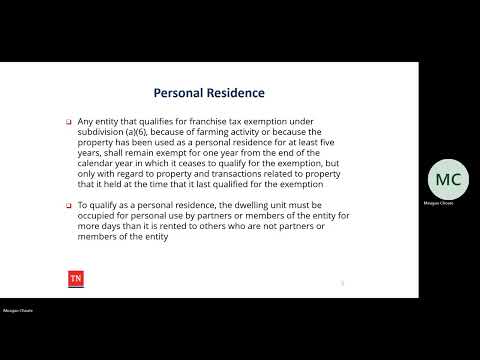
For personal-residence treatment, Choate said the property must have been used as a personal residence for at least five years to satisfy subdivision (a)(6); if the property later ceases to qualify, the exemption continues for at least one year from the end of the calendar year in which it ceased to qualify, but only for transactions related to the property held at the time it last qualified. She also explained the occupancy test: the dwelling must be occupied for personal use by partners or members for more days than it is rented to non-member tenants.
To claim or renew the exemption, Choate instructed entities to file Form FAE 183. If an entity does not meet exemption requirements in a given year, it must file a franchise and excise tax return (Form FAE 170) and pay taxes for that year. The department requires Form FAE 170 to be filed electronically with payment by the fifteenth day of the fourth month following the close of the taxable year.
Both initial claims and annual renewals of the exemption (Form FAE 183) must be submitted by the fifteenth day of the fourth month after the entity’s year end. Choate warned that failure to timely file an application or renewal may result in assessment of a $200 penalty.
She also noted that entities that obtain a federal income tax extension are automatically granted an extension for Tennessee franchise and excise tax when the filer checks the box indicating a federal extension is on the application.
Choate closed by directing viewers to the Tennessee Department of Revenue website (tn.gov/revenue) for the FAE 183 and FAE 170 forms and instructions, the franchise and excise tax manual, and statutory references; she provided the department’s general and franchise/excise tax phone lines and an email address for additional questions.
The department did not announce changes to statutes or forms during the presentation; the webinar focused on explaining existing eligibility criteria, filing deadlines and where to find the formal application materials.