Get Full Government Meeting Transcripts, Videos, & Alerts Forever!
Get email alerts on the Human Services Budget topic
No spam. Unsubscribe anytime.
Greenwich human services director flags rising rent-assistance costs and outlines FY27 budget plan
Summary
Department of Human Services Director Demetria Nelson told BET budget reviewers the department seeks a 2.53% FY27 increase driven largely by salary costs and growing rent-assistance outlays; she described eligibility caps, community partnerships, ARPA/opioid fund uses, and the Fair Rent Commission’s caseload.
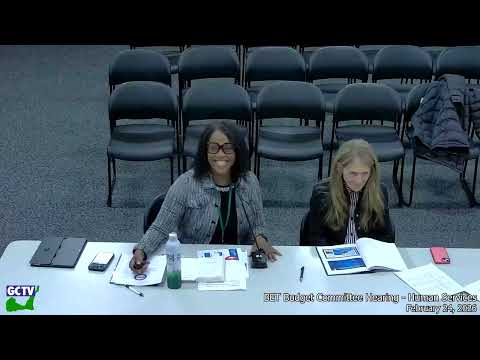
Demetria Nelson, director of the Town of Greenwich Department of Human Services, told the Board of Estimate and Taxation during a May budget hearing that the department is proposing a 2.53% overall increase for FY27, driven primarily by salaries and a rise in rent-assistance spending.
Nelson said the department has seen a gradual increase in clients since the pandemic, which she attributed to changes in benefit levels and continuing inflation that stretch household budgets. She told the BET that FY25 spending on rent assistance rose substantially even though the number of requests did not increase at the same rate. The presentation noted the department served 4,253 individuals in FY25; the households count on the slide was unclear in the transcript and the department has been asked to provide the corrected figure.
Why it matters: the department’s emergency rental support is a short-term subsidy intended to prevent evictions, and higher per-case payments strain client-aid line items. BET members pressed for clarity on whether funds had been reallocated and how additional needs would be managed without creating gaps in other emergency programs.
Nelson described the department’s intake and case-management model: an admissions and applications unit for resource-level needs and a case-management team staffed by licensed social workers for clients with complex needs. She said the department does not provide formal therapy but offers supportive counseling and referrals to clinical services.
On eligibility and award limits, Nelson said the department generally requires applicants to have no more than $3,000 in liquid assets and household income at or below 300% of the federal poverty level (the presentation gave about $95,000 for a family of four). She also said the department’s current maximum award cap was presented as $4,200 every two years. Committee members asked for written confirmation of these caps and of how asset and income calculations are applied in practice.
Nelson emphasized that rent-assistance payments are subsidies, not loans. She described one local arrangement in which the town can place funds toward a security deposit and recover the deposit from the landlord if a resident moves; she also referenced an external lender (name not captured in the record) that offers small repayment loans to residents.
Community partnerships and operating items: Nelson outlined $891,400 in community partnership funding with no overall increase requested for FY27 and noted one new program from an existing partner—Sparks and Space (Jewish Family Services)—budgeted at $6,000. She called out measurable outputs supported by town funding: more than 2,100 middle-school counseling sessions through a youth program, more than 83,000 diapers distributed via a partner nonprofit, almost 4,000 one-way rides for seniors through Riverhouse, and 2,455 counseling contacts supported at the YWCA of Greenwich.
ARPA and opioid-settlement funds: Nelson said remaining ARPA-funded initiatives will phase out and the department is considering opioid-settlement funds to sustain behavioral-health pilots and prevention efforts. She noted internal fiscal-year planning targets (June 30) and a stated spending deadline of December 31, 2026 for some opioid-settlement distributions; Nelson said she would provide BET with a report showing how opioid-settlement funds have been spent to date.
Fair Rent Commission: Nelson reviewed the commission’s first annual report. In FY25 the commission received eight complaints (one did not meet criteria), held two hearings, and resolved some matters through mediation as required by ordinance. For the current year the presentation listed nine complaints and three hearings to date, and Nelson said the largest rent increase reported in a complaint was 45% so far. The commission uses a part-time coordinator and mediations; Nelson said a coordinator who could be trained as a mediator would help manage workload.
Staffing and small contracts: Nelson explained temporary-salary increases mainly reflect afterschool and summer program staffing needs and minimum-wage pressures. Line-item requests include modest increases for ClientTrack licensing (~$2,000), vehicle rentals for youth programs, enrichment contractors for afterschool activities, a small marketing/video request for the Fair Rent Commission (presented as $3,000 toward an estimated $4,000 video), and a DocuSign contract to enable remote signatures.
What’s next: BET members asked for larger-slide copies and requested follow-up materials, including a clearer household-served count, an opioid-settlement spending report, and confirmation that current practice aligns with the original settlement resolution. Nelson agreed to provide the documents and consult with the law department where needed.
The budget hearing continued after a short break.