Get Full Government Meeting Transcripts, Videos, & Alerts Forever!
Get email alerts on the Village At Pch Amendment topic
No spam. Unsubscribe anytime.
Lompoc planning panel approves amendment for Village at PCH housing project, shifting from SB 35 to state density bonus
Summary
The Lompoc Planning Commission on April 8 approved an amendment to the Village at PCH residential project that relies on the state density bonus law rather than SB 35 streamlining; the commission approved the amendment 3-0 after debate over prevailing-wage requirements, parking and whether applicants may use SB 35 to speed initial approvals.
The Lompoc Planning Commission voted 3-0 on April 8 to adopt an amendment to the Village at PCH residential project that removes the project’s SB 35 ministerial designation and instead relies on the state density bonus law for incentives, concessions and waivers.
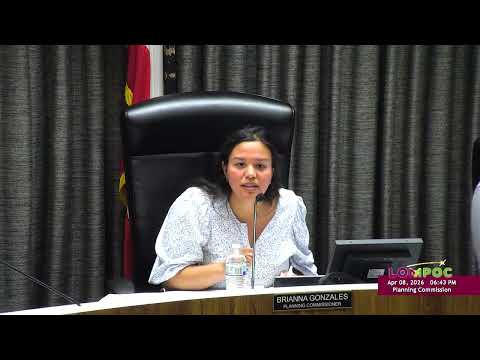
The approval, adopted by roll call after a public hearing, allows the previously approved 86-unit development at 917 East Walnut Avenue to proceed with conditions updated per engineering staff. Commissioners Gonzalez, Bridge and Herd voted yes; two commissioners were absent.
Staff told the commission the Village at PCH is a planned residential development on roughly 2.87 acres, consisting of 86 units in a mix of building types and proposing eight units deed-restricted to very-low-income households. The project proposes 98 parking spaces; staff said the earlier SB 35 processing and the density-bonus analysis produced different parking calculations and waiver options.
"We are doing innovative housing throughout California," said project representative Ted Lton of Bailey Financial Group, explaining the applicant’s choice to file as a rental project initially so modular units could be manufactured and construction would not be delayed while processing a condominium map. "We have projects from Sacramento to San Diego and we're trying to find solutions to help solve our housing and homeless crisis."
Several commissioners and members of the public sought clarification about why the project was processed under SB 35 and is now coming to the commission for a discretionary amendment. Christian Brownstein, the applicant’s land use attorney, said SB 35 provides a 60-day ministerial "shot clock" for certain approvals but does not include subdivision-map processing; applicants often file as rental projects under SB 35 and later submit maps to create for-sale parcels.
Commissioners also pressed staff and the applicant on prevailing-wage requirements tied to SB 35. Staff explained that removing the SB 35 designation eliminates the SB 35-related prevailing-wage condition; the applicant and project representatives said recent bid results left the project millions of dollars over budget and that seeking the prevailing-wage waiver was necessary to keep the development financially viable.
"In order for this project to pencil because we want to keep our price points and sales down, we really need this prevailing wage waiver," one project representative said during public comment. The project team also said they are using local contractors where practicable for site work, while modular building components are manufactured offsite.
Commissioner Herd raised safety-related questions about reduced building separation, noting Lompoc’s local planning code calls for a 10-foot separation while the California building code can require a smaller minimum (staff said five feet in relevant scenarios). Staff said the requested 6.5-foot separation meets state building-code minimums and was considered in the SB 35 approval but requires a local waiver/concession as part of the density-bonus benefits.
Staff recommended adoption of the amendment (referenced in the staff report by resolution and amendment numbers) with an engineering wording change; the commission moved to adopt the resolution with the engineering condition changes and approved it by roll call vote.
Next procedural steps noted at the meeting: if the applicant later seeks to make units for sale, a subdivision or condominium map must be processed and recorded; the deed-restriction covenant documenting the affordability term will be recorded per density-bonus requirements. Counsel and staff said the state density bonus framework generally requires lengthy affordability terms (discussed at the hearing as 55 years), and the exact duration will be specified in the recorded covenant.
The commission continued other agenda items to the May 13, 2026 meeting and adjourned.