Get Full Government Meeting Transcripts, Videos, & Alerts Forever!
Get email alerts on the Water Infrastructure topic
No spam. Unsubscribe anytime.
Farmers Branch staff outline multiyear water-main replacements and meter modernization
Summary
Public Works reported replacing about 27,000 feet of water main since 2022, a planned 2026 construction program of roughly 19,000 feet, a five-year plan to replace about 15 miles of mains and an ongoing meter-replacement program tied to an ITRON customer portal rollout and estimated nonrevenue water savings.
Hines, a utility compliance and contract coordinator in Public Works, told the Farmers Branch Sustainability Committee the city has replaced roughly 27,000 feet of water main since 2022 and is designing its 2026 capital improvement program that includes a little over 19,000 feet of replacement this year and additional work on a transmission main.
"Since 2022 we've done 27,000 ft of water main replacement," Hines said, describing work across 6-inch to 12-inch mains and a multi-year schedule. He added the city’s five-year replacement plan anticipates more than 15 miles of main replaced between 2027 and 2030.
Craig Hut, introduced as the city’s utility superintendent, outlined the large-meter replacement program that targets meters three to ten inches in diameter. Staff said the city has about 200 large meters, replaced about 48 in 2024–25, and tests meters annually to identify underperforming units.
"Of those ones that are starting to fail we add them to the replacement list and get a project to get those," Hut said, describing post-replacement testing that raised meters from lower accuracy up toward near 100 percent and thereby recovered previously undercounted, billable water.
Staff told the committee that meter replacements and leak-prevention efforts contributed to an estimated 1.5 million gallons of recovered (nonrevenue) water in the period shown by recent testing. They framed meter accuracy improvements as both a revenue and conservation measure.
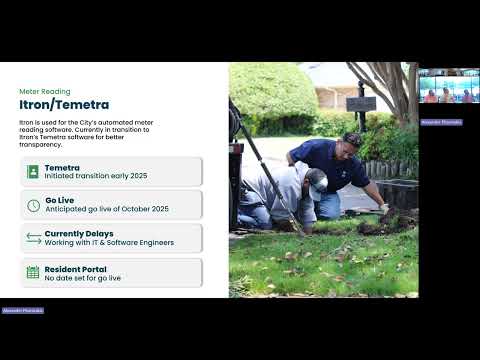
The presentation also covered the city’s move to a new meter-reading and customer portal based on ITRON software (referred to in the meeting as "Metro"). Staff said the anticipated October 2025 go-live date has slipped; the system will provide hourly reads in the customer portal, leak-detection flags and resident-set notification parameters (email or text). Public Works invited committee volunteers to beta-test the portal and suggested door-hanger QR codes and one-page guidance to help residents set alert thresholds.
On distribution losses, staff said they completed the 2025 water-loss audit showing about 9.5 percent water loss for the calendar year; field crews record estimated gallons lost on work orders when responding to breaks, and that data feeds the annual audit.
The presentation included technical details on wastewater main materials, with staff noting newer installations use PVC while the city still maintains older clay lines and is employing pipe-burst methods for replacements.
Next steps: staff will continue CIP design work, pursue the meter portal roll-out with beta testing and return to the committee with additional updates as projects move into construction and service changes are staged.