Get Full Government Meeting Transcripts, Videos, & Alerts Forever!
Get email alerts on the Police Staffing topic
No spam. Unsubscribe anytime.
Police officials tell House commission Bill 1141 would limit superintendent’s flexibility on recruit assignments
Summary
At a public hearing on Bill 1141, police legal counsel and labor-relations officials said the measure — which would require initial assignment of academy graduates by domicile — duplicates existing policies and could leave high-need jurisdictions understaffed. The commission requested written data from the police within five days.
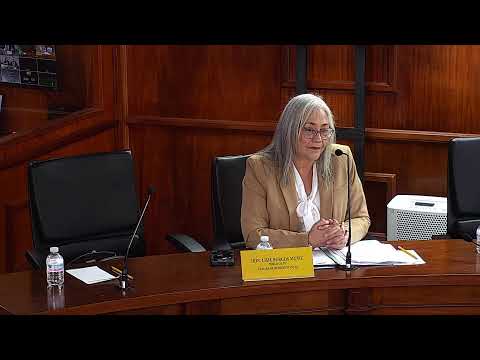
The Puerto Rico House of Representatives' Commission on Public Safety held a public hearing on Bill 1141, which would amend Article 9 of Law 83-2025 to give preference—and in some cases mandatory initial assignment—by domicile for recruits graduating from the Police Academy. The commission’s vice president presided in place of the excused president, Representative Félix Pacheco.
José Carlos Vázquez Rivera, legal adviser to the superintendent of the Puerto Rico Police, told the committee the agency opposes the bill “not because it is not a good idea, but because the ideas that are in that bill are already implemented in the Puerto Rico Police.” He described a 2018 staffing needs study (updated in 2023 by Bitway) that found resources were poorly distributed and many functions performed by officers could be civilianized; the agency created a redistribution plan and committee to address those findings.
Angélica Rodríguez Rodríguez, director of the Office of Labor Relations and member of the redistribution committee, described a process of monthly monitoring and electronic dashboards that identify critical units. She said the committee issues certifications recommending transfers “conforme a los tableros” and that the superintendent retains discretion to approve or deny moves: “Queda discreción del superintendente avalar el movimiento, o no.”
Committee members pressed agency officials on operational trade-offs. Legislators and witnesses warned that a statutory mandate to assign recruits by domicile could have unintended effects in areas with concentrated demand for police services. One representative cited the agency’s figure that roughly 3% of officers live in the San Juan area, and witnesses said San Juan carries a disproportionate share of calls and staffing needs. Vázquez warned that implementing a domicile-based assignment “as it is drafted” could be “irremediable” for public safety if applied abruptly.
Lawmakers asked about alternatives and retention measures. Witnesses said the superintendent and the governor’s administration are working with the Office of Management and Budget and the Fiscal Oversight Board on compensation and benefit changes—examples cited included reviewing salary scales, increasing health-plan contributions, and adjustments to toll reimbursements—to help attract and retain officers. Agency witnesses also described cases where high-performing candidates for promotion can choose assignments and noted that transfers have been managed to reduce waiting lists (the administration reduced a five-year requirement for some transfers to four years).
The commission requested that the Puerto Rico Police provide written responses within five days addressing specific economic-impact and staffing questions, including statistics on how domicile-based assignment would affect coverage in high-need jurisdictions. The hearing concluded at 10:16 a.m.
What’s next: The committee will review the written information provided by the police and use those responses to inform its final report and any proposed amendments to Bill 1141.