Get Full Government Meeting Transcripts, Videos, & Alerts Forever!
Get email alerts on the Public Transit topic
No spam. Unsubscribe anytime.
Rep. Jones proposes metrics, coordination and land tools to boost Twin Cities transit; counties press for safeguards
Summary
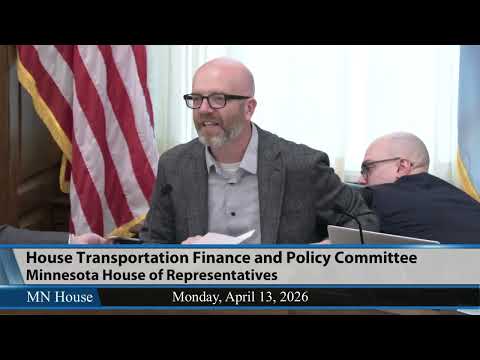
House File 4449 would require performance metrics for the Twin Cities transit system, create a transit investment framework and permit the Met Council to acquire land to promote transit-oriented development. Supporters cited ridership and equity goals; counties and some members raised concerns about local control, fiscal impact and safety exemptions. The bill was laid over.
Representative Jones presented House File 4449, "Transit for a Resilient Metro," as a package to increase ridership and make the transit system more efficient. She told the committee there are three central problems—no numeric goals for service and ridership, poor coordination between roadway and transit projects, and lack of tools to enable transit-oriented development—and offered targets for high-frequency access, operating cost per passenger and measures of speed and reliability.
"Do we want a growing Twin Cities metro that can compete with peers and a place where businesses and residents can thrive?" Jones asked, arguing that clear metrics and a transit investment framework will steer capital and operational dollars to corridors where transit can succeed.
Representative Olson and other members pressed for an amendment to exempt projects that are primarily safety-driven from the bill’s coordination requirements. Olson said safety work—new signals, lights or other urgent fixes—should not be saddled with additional costs to meet transit coordination rules. Jones said the bill was intended to cover substantial corridor projects that require heavy reconstruction and to encourage doing transit work once when road projects already occur.
A recorded roll-call vote was requested on the safety amendment; the transcript records a roll call and indicates the motion did not prevail. Later amendments proposing opt-outs for local cities and clarifying committee authority were debated; several local officials including a Scott County commissioner warned the bill, as written, could redirect county sales-tax funds without a clear appeal process and could leave counties with no equivalent opt-out.
Hennepin County leadership and transit advocates testified in support. Hennepin County's commissioner (recorded in the transcript as Commissioner Green) said the region benefits from coordinated funding and noted that billions in development have clustered near high-frequency transit corridors. Mov Minnesota’s MJ Carpio urged performance measures and a framework to translate funding into service improvements and development near stations.
Committee members expressed support for metrics but also sought clearer language on safety exemptions, county input, the geographic scope of transit-oriented development and the fiscal note. Representative Jones said she was open to continued conversations and the bill was laid over for further work.