Get Full Government Meeting Transcripts, Videos, & Alerts Forever!
Get email alerts on the Program Integrity topic
No spam. Unsubscribe anytime.
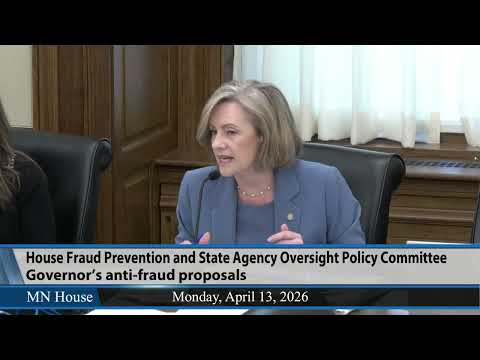
Minn. committee hears governor's anti-fraud package; lawmakers press over "credible allegation" standard
Summary
Agency witnesses outlined a broad Medicaid-focused program-integrity package — new pre-enrollment risk reviews, expanded electronic visit verification, managed-care oversight and funding for auditors — while lawmakers warned the proposed "credible allegation" language could limit swift action on whistleblower tips.
Chair Robbins convened the House Prevention and State Agency Oversight Committee to hear the governor's anti-fraud package and agency testimony on strengthened program integrity for Medicaid and other state programs. Minnesota Department of Human Services Commissioner Shireen Gunn told the committee the package aims to "ensure taxpayer dollars are spent as intended and protect vital services," citing a mix of prepayment and post-payment analytics, tighter provider enrollment checks, and licensing reforms.
The package centers on three elements described by Gunn: a data-driven pre-enrollment risk assessment process for providers, shortened timelines for validating high‑risk providers, and enhanced oversight of managed‑care organizations. Gunn said proposals would expand electronic visit verification to additional home and community‑based and some behavioral health services; add billing limits and 15‑minute billing units; and move several mental‑health service standards from certification to licensing. She said the measures affect programs that "cover more than 1 million people." "There is no tolerance for fraud in our programs," Gunn said.
Minnesota Management and Budget staff described related funding requests to add internal-control specialists, auditors and an enterprise approach to withhold payments where credible allegations exist. Chris McNulty, general counsel for Minnesota Management and Budget, summarized the intended legal standard, saying the language envisions a "credible allegation of fraud [that] has been verified," meaning there must be some basic, demonstrable credibility to an allegation before agencies act. The Bureau of Criminal Apprehension asked for staffing increases (the BCA requested eight additional investigators and intelligence analysts) and broader subpoena and identity-theft definitions to account for AI‑enabled schemes.
Why it matters: DHS officials said the package would modernize data, analytics and staffing across enrollment, claims review and auditing; managed‑care organizations account for the majority of Medicaid enrollees and are central to the state's ability to prevent and detect improper payments. MMB framed its fiscal requests as investments to operationalize cross‑agency controls and implement recommendations from recent program‑integrity reviews.
Where lawmakers pressed: Several members warned that the proposed phrase that a credible allegation must be "verified by the head of an agency" risks requiring too much investigation before agencies can act on whistleblower complaints. A committee member noted hundreds of whistleblower reports that were alleged to have been ignored, voicing concern that a verification requirement could "hamstring" early action. Erin Campbell (Minnesota Management and Budget) and McNulty said the intent was to create a workable, administrable standard and not to require full investigations before a withholding, and they cited prior agency use of similar authority.
Several members also pressed for stronger cross‑agency data sharing and for an inspector general with independence and teeth. MMB noted a one-time investment in FY27 to improve agencies' data-sharing and identity‑verification capabilities and described a proposal for a state inspector general with authority to access agency investigative files. Some members said the package still lacks enforceable accountability and urged further work with the Office of the Legislative Auditor.
What comes next: Agency leaders said they would continue to work with legislators to refine the statutory language. The committee did not vote on the package; members asked staff to return with revised language and follow-up materials, including data and examples about whistleblower referrals and MCO reporting obligations.