Get Full Government Meeting Transcripts, Videos, & Alerts Forever!
Get email alerts on the Student Loan Repayment Program topic
No spam. Unsubscribe anytime.
Department of Health Care Access and Information launches Medical Behavioral Health Student Loan Repayment Program with $93.3 million available
Summary
The Department of Health Care Access and Information launched a Medical Behavioral Health Student Loan Repayment Program offering up to $93.3 million this cycle, with individual awards up to $240,000 and service obligations of two to four years tied to work in eligible California medical safety‑net settings. Applications open May 1 and close May 29.
The Department of Health Care Access and Information announced the Medical Behavioral Health Student Loan Repayment Program, a grant initiative that aims to expand behavioral‑health staffing in California’s medical safety‑net by reducing student debt and incentivizing service in eligible settings.
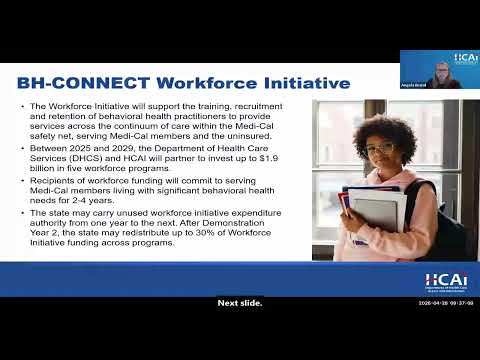
"Our work is about creating a healthier California where every person, no matter where they live, has access to equitable, affordable, and high‑quality care," said Angela Brand, section chief for behavioral health and policy, as she introduced the BH Connect workforce investments that include the loan repayment program.
Why it matters: The program is part of California’s BH Connect transformation and follows federal approval of a BH Connect 1115 demonstration waiver and related state plan amendments, which enabled federal funding and STC (special terms and conditions) arrangements that govern award amounts and administration.
Program basics: Samantha Sadler, behavioral health policy specialist, said the state has up to $93.3 million available in this cycle. Awards vary by profession: some clinical specialties (including addiction medicine physicians, psychiatrists, nurse practitioners and physician assistants) are eligible for awards up to $240,000, while many licensed clinicians are eligible for up to $180,000 and counselors, peer specialists and community health workers are eligible for up to $120,000. Award amounts cannot exceed an applicant’s remaining eligible educational debt at the time payment is issued.
Service obligations are tied to award size: generally a four‑year obligation for larger awards; awards under $10,000 carry a two‑year obligation, and mid‑range awards carry a three‑year obligation, per program guidance. Recipients must serve in medical safety‑net settings (examples: federally qualified health centers, county community mental health centers, rural health clinics) and in sites that meet payer‑mix thresholds cited in the grant guide (for example, hospitals and certified treatment programs serving 40% or more Medicaid and/or uninsured patients; rural health clinics with at least 30% Medicaid/uninsured populations).
Eligibility and full‑time requirement: Grantees must perform full‑time direct client care as defined by HAI — a minimum of 32 hours per week providing direct care, or 30 hours per week in school‑based behavioral health settings. Direct care includes face‑to‑face and telehealth clinical services, prevention, assessment, treatment, documentation and first‑line supervision when that supervision directly oversees staff providing client care.
Application process and timeline: Jessica McIntyre, program manager, said the application portal opens May 1 at 3 p.m. and closes May 29 at 3 p.m.; award notices are expected in September and grant agreements are proposed to start in October. Post‑award payments will be issued directly to loan servicers between November 2026 and November 2027. Applicants must upload current loan statements showing account numbers and balances, unofficial transcripts to document qualifying education, current license/credential, and provide employer contact information so the employer can complete an online employer verification form (EVF); an application is incomplete until the EVF is submitted.
Scoring and prioritization: Applications will be scored on multiple factors (examples given by staff include language capacity, prior participation in publicly funded programs, prior experience in medical safety‑net settings, whether the applicant works in an HAI‑identified shortage area and whether they work at medical specialty behavioral health sites). HAI said it intends to balance geographic distribution and specialty needs across awards and may give preference to applicants who support underserved regions or market types.
Breach and waiver policy: HAI will recoup payments if a grantee fails to meet service or grant obligations; awardees are advised to review the grant guide for waiver policy. Presenters emphasized that the service obligation begins at the grant agreement start date and that past service does not shorten the future obligation.
Common questions addressed in Q&A: Presenters clarified that sites need not be nonprofit to qualify but must meet medical safety‑net definitions; sites are not pre‑approved — eligibility is determined during EVF review. Individuals need not have an individual NPI, but the practice site must provide a valid site NPI. Loans in deferment or forbearance may be eligible if current and not in default. Applicants must have completed the education that produced the loans at application time; students with incomplete degrees are advised to consider HAI scholarship opportunities instead.
Contact and resources: Program staff said the slide deck, grant guide and recording will be posted on the program resources page after the webinar. For program questions, staff directed attendees to the program email (corrected from the transcript formatting) mbhslrp@hai.ca.gov and a BH Connect helpline at (916) 326‑3899.
The application window opens May 1 at 3 p.m. and closes May 29 at 3 p.m.; applicants should review the 2026 grant guide and employer verification requirements before submitting.