Get Full Government Meeting Transcripts, Videos, & Alerts Forever!
Get email alerts on the Flood Insurance topic
No spam. Unsubscribe anytime.
Lawmaker urges Congress to act as rising flood-insurance costs push Louisianans out of coverage
Summary
On the Senate floor a lawmaker warned that recent FEMA rate changes have made National Flood Insurance Program coverage unaffordable for many Louisianans, cited tens of thousands who dropped coverage, and said he has introduced legislation to keep the program operating during lapses in authorization.
On the Senate floor a lawmaker warned that hurricane season is less than three weeks away and urged Congress to act to make flood insurance affordable again, saying "Every year, more and more people have to drop the National Flood Insurance Program coverage because it is too expensive and too unreliable."
The lawmaker said that between 2022 and 2024 "70,000 people in Louisiana dropped coverage, and last year, another 52,000 did," and blamed FEMA's Risk Rating 2 for steep premium increases. He said Risk Rating 2 was implemented "even though Congress never gave approval," and added that since 2023 "rates have increased, making people's flood insurance premiums so high they cannot afford them."
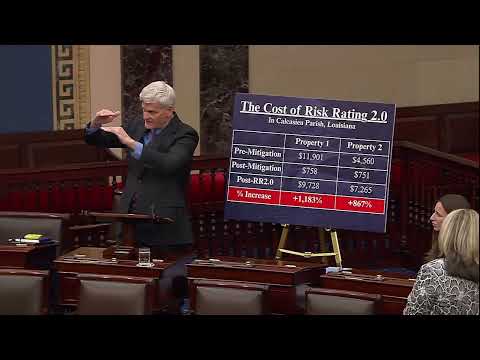
The lawmaker gave local examples in Calcasieu Parish, saying one property faced almost a $12,000-per-year premium and another saw an 876% increase under the new risk framework, calling those outcomes "unaffordable for a middle income family." He described a 2016 river crest that destroyed an elevated home despite mitigation efforts to underline that even properly sited properties remain at risk and therefore need accessible insurance.
As a legislative remedy, the lawmaker said he has introduced a bill to automatically extend the National Flood Insurance Program when authorization lapses so the program "can still issue policies, renew contracts, pay claims, and access funding." He also cited past efforts, saying he worked with the Trump administration in 2019 to delay Risk Rating 2 for a year and is leading colleagues pressing FEMA and Congress to address the issue.
The speaker highlighted federal mitigation funding and projects as part of reducing long-term insurance costs, noting BRIC (Building Resilient Infrastructure and Communities) grants and a newly released $1,000,000,000 round intended to help states hit by disasters. He credited the Infrastructure Investment and Jobs Act and other mechanisms for delivering hundreds of millions of dollars for flood mitigation, saying he helped secure about $615,000,000 for the Morganza to the Gulf project and that partial construction of that project helped prevent flooding of roughly 10,000 homes during Hurricane Ida.
The lawmaker framed prevention and reliable insurance as complementary: prevention lowers future claims and federal liabilities, while affordable NFIP coverage protects families when disasters occur. He closed by urging Congress to act responsibly to ensure "reliable, accountable, affordable flood insurance" and said he would continue seeking federal investment and policy fixes before yielding the floor.