Get Full Government Meeting Transcripts, Videos, & Alerts Forever!
Get email alerts on the Cri Funding topic
No spam. Unsubscribe anytime.
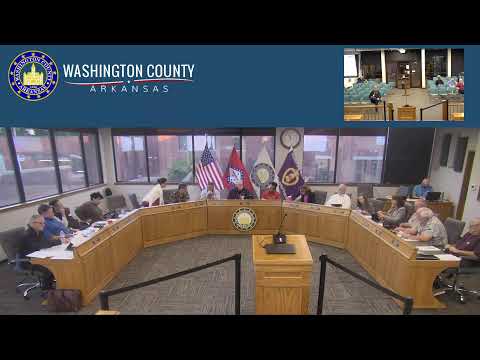
Washington County debate centers on cost, staffing and outcomes of CRI program
Summary
Quorum court members debated whether to include county detention-officer salaries in the Community Rebuilding Initiative (CRI) cost-per-bed calculation, heard a 19.38% year‑one return-to-incarceration figure, and voted to advance a funding ordinance to the full quorum court.
Comptroller Sherman presented a line-by-line accounting of the Community Rebuilding Initiative’s (CRI) first grant year and a year-two estimate, telling the court the grant is reimbursable up to $355,000 and that county match and county-paid services remain the largest local costs. "The way it works is they tell us the number and then we submit to them, okay," Sherman said, describing monthly reimbursement submissions to the grantor.
The central dispute was whether to count county-paid detention deputies reassigned to the CRI when calculating the program’s cost per bed. Sherman said deputy pay is a county expense and that eight deputies were reassigned; he characterized the $710,000 staffing estimate as the single biggest line. "That is the biggest expense down there right now is the detention officers with the benefits and salaries," Sherman said.
Justice of the Peace JP Koger and others argued those deputy hours represent real county labor resources devoted to CRI and therefore should be included in the program’s per‑detainee cost. Koger told the court reassignment created strain at the main jail and that comparing staffing ratios shows CRI requires a higher staffing level than the main jail. "The CRI requires a significantly higher staffing ratio — 2 deputies for 30 beds versus 2 deputies for 96 beds at minimum security," Koger said.
Sherman showed two cost-per-bed calculations. Using full 30-bed capacity he computed about $91.64 per bed; using an observed average census of 24, he raised that figure to approximately $114.55 per detainee. Program staff cautioned the figures reflect ongoing estimates: "I'm assuming... for the year, if they're asking for $1.69 (million) maybe that, you know, it's close," Sherman said as he walked through accounting assumptions.
Program representative Nick (CRI staff) gave preliminary outcome data the court requested. "Over the first 12 months ... we're at a 19.38 percent of return to incarceration," Nick said, noting the number covers only year‑one graduates and that best practice for recidivism analysis typically uses a three‑year window.
Multiple justices and citizens urged caution and further review before making major new funding commitments. Citizen Bryson Austin said the initiative was billed as a three‑month pilot and urged the court to pause for a formal assessment: "We have not seen the evidence for what this program is doing," Austin said.
Procedurally, the court voted to advance an ordinance (item 10) amending the CRI GRAMA fund for 2026 to the full quorum court with a 'do pass' recommendation; the motion was made by JP Eke and seconded by JP Pond. Several members said they supported CRI’s goals but wanted clearer budget breakout and longer outcome measurement before committing county general funds permanently. The matter will return to the full quorum court for final action.
Next steps: the court asked staff to provide a more detailed breakout of payments to Arisa Health and Returning Home, to supply a recidivism comparison to main-jail populations, and to update cost‑per‑detainee figures as the program completes its second year of operation.