Get Full Government Meeting Transcripts, Videos, & Alerts Forever!
Get email alerts on the Military Equipment Policy topic
No spam. Unsubscribe anytime.
Police Oversight Commission recommends revisions to SAPD military equipment policy and forwards draft to city manager
Summary
The Santa Ana Police Oversight Commission voted May 14, 2026 to approve recommended revisions to SAPD Policy 707 (military equipment) and forwarded the draft to the city manager for review and possible council consideration; commissioners urged clearer reporting on harm reduction alongside cost-effectiveness.
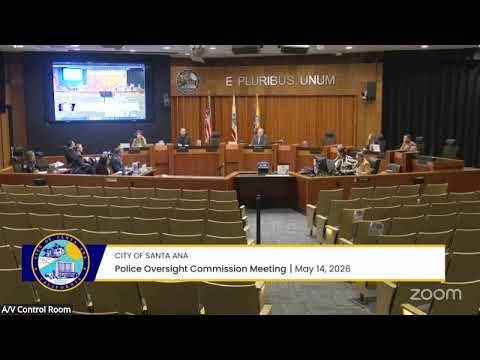
The Santa Ana Police Oversight Commission on May 14, 2026 voted to approve recommended revisions to SAPD Policy 707, the department's military equipment policy, and to forward the draft to the city manager for internal review and potential elevation to the City Council.
Police Oversight Director Jack Morse, who presented the rewrite, said the changes align the policy with state requirements and clarify what the annual military equipment report must include. "The policy now makes clear that the chief of police has authority to ensure compliance with policy 707," Morse said, adding that the annual report will include information so the City Council can determine whether equipment is necessary, whether reasonable alternatives exist, and whether use safeguards public welfare, safety, civil rights and civil liberties.
The vote follows a technical presentation and back-and-forth with commissioners about where operational details should live. Morse said 707 is intended to be an inventory and statutory roadmap; operational parameters for less-lethal devices and assemblies remain in other SAPD policies (use-of-force, control devices, First Amendment assemblies) that are under separate review.
Several commissioners urged the commission to consider harm reduction and not rely solely on a cost-effectiveness standard when evaluating equipment used at demonstrations. One commissioner said, "Just because it's the most cost effective equipment doesn't mean that it is the less harmful," and recommended adding explicit reporting language or pursuing a follow-up work session with civil liberties groups. Director Morse replied that the current draft faithfully reflects statutory language but that the commission can propose further detail in the related operational policies or pursue outreach and additional review before next year's submission.
A motion to approve the draft policy was made and seconded; the recording secretary conducted a roll-call vote and the motion carried (five ayes, no nays) with Commissioners Mejia and Vice Chair Castillo Lawton absent. The commission's approval sends the recommended policy to the city manager, who has 30 days (with a possible 30-day extension) to respond; if the commission is dissatisfied with the city manager's decision it may elevate the policy to the City Council.
The director said the revised policy adds explicit citations to applicable federal and state law, specifies which SAPD policies govern use of particular equipment, and includes strengthened language on how complaints related to Policy 707 will be submitted and addressed. Commissioners discussed whether the commission should invite outside legal or civil liberties organizations to a future study session; some members suggested approving the draft now to meet state reporting timelines and then pursuing additional input for subsequent iterations.
The commission will forward its recommendations to the city manager and may revisit operational policy changes separately. The commission did not adopt operational-use changes at the May 14 meeting.
The commission's action closes the item at the commission level; the city manager and, ultimately, City Council retain authority to approve or alter the department's military equipment policy.