Get Full Government Meeting Transcripts, Videos, & Alerts Forever!
Get email alerts on the Energy Policy Subsidies topic
No spam. Unsubscribe anytime.
Secretary Chris Wright tells Cato crowd IRA subsidies risk higher prices, distorted markets
Summary
U.S. Energy Secretary Chris Wright argued at a Cato Institute conversation that large subsidies in the Inflation Reduction Act and IIJA distorted electricity markets, inflated costs and harmed nuclear generation, and urged market-structure reform.
Secretary of Energy Chris Wright criticized the scale and design of recent federal energy subsidies on stage at a Cato Institute event, saying the Inflation Reduction Act and related programs have warped electricity markets and driven up costs.
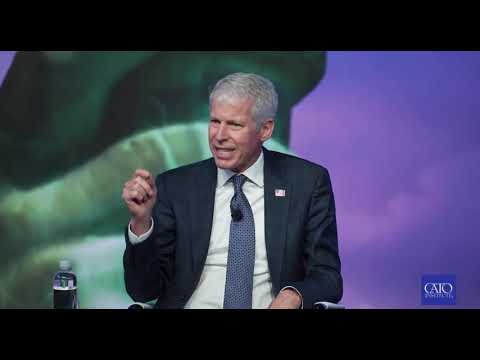
Wright, speaking in conversation with Travis Fisher, Cato's director of energy and environmental policy, said the Congressional Budget Office had substantially underestimated the cost of energy-oriented subsidies and that the IRA contained roughly $1,000,000,000,000 in energy subsidies over 10 years. "We're gonna spend 1 to $2,000,000,000,000, and it's guaranteed that it will make electricity more expensive and our grid less reliable," Wright said.
Wright framed his critique on two fronts: the scale of taxpayer support and the market effects of subsidies such as the production tax credit (PTC). He described a scenario in which subsidized wind generation can push wholesale prices negative: "for every kilowatt hour, we mail them a 4¢ subsidy check to the wind ... They also have a contract from the utility that pays them for that stuff," he said, arguing that those payments come even when added generation displaces cheaper gas-fired output and increases long-term rate base costs through added transmission.
Wright said he tried during reconciliation negotiations to reduce the size of the subsidy package and believes the final adjustments cut about half of the originally scored amount. "I didn't get anywhere near my goal of killing $950,000,000,000 of the trillion, but we did kill by the scoring about 500,000,000,000," he said.
On nuclear power, Wright said government policy had "strangled fission nuclear energy," leaving the sector uncompetitive for decades and limiting its ability to provide 24/7 baseload and process heat. He argued that reviving industrial-scale fission would address process-heat needs that hydrocarbons currently supply.
Why it matters: Wright presented a market-centered argument that poorly designed subsidies not only transfer public money but also change investment signals, potentially inducing higher prices and eroding other technologies' competitiveness. He recommended wholesale-market reforms to attract long-term capital for reliable electricity generation.
The conversation at Cato included questions about the pace and location of future energy innovation, with Wright pointing to continued incremental gains in hydrocarbons alongside possible breakthroughs in fusion, geothermal and industrial fission. Wright's remarks were part of a broader event at which he also answered audience questions on Venezuela, critical minerals and permitting.
The session concluded without any formal policy action; Wright and other speakers moved to a reception.