Get Full Government Meeting Transcripts, Videos, & Alerts Forever!
Get email alerts on the Academic Performance topic
No spam. Unsubscribe anytime.
Principals showcase district gains as board debates AP access and program rigor
Summary
At a Greenwich School District retreat, principals highlighted building-level gains in literacy, math and science and district strategies such as PLCs, data trackers and extended learning. A detailed presentation on AP, honors and ALP prompted debate on access, teacher recommendations and student stress.
At a special retreat, Greenwich School District administrators and school principals presented building-level academic “points of pride,” describing how district strategies translated into classroom practice.
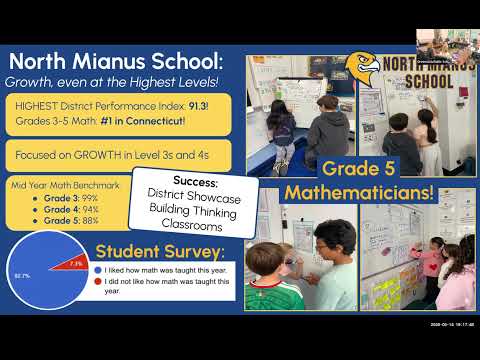
Dr. Jones and senior administrators framed the evening around the district strategic plan and asked principals to speak from the classroom. Principals described uses of actionable data, PLCs and targeted instruction: Glenville used NWEA screening and tiered instruction to speed remediation and acceleration; North Marianas reported 88 fifth-graders meeting the midyear math benchmark with 62% at the highest level; North Street emphasized hands-on NGSS-aligned science and 106 students in its elementary science fair; Parkway and other elementary schools stressed reading comprehension strategies applied across content areas; and Greenwich High School credited MTSS, AVID and credit-recovery programming for a reported 98% graduation rate this year.
The presentations underscored shared tactics—peer observation, vertical whiteboards for collaborative math discourse, weekly PLCs and extended learning time (before/after school and Saturday programs)—that leaders said are being shared across the district’s priority-school cohort. Several principals noted substantial staff turnover at times in particular buildings and emphasized concentrated efforts to build trust and school culture in response.
A longer district briefing on advanced coursework sparked more sustained debate. District staff summarized a decade of AP participation and results, noting a roughly 35% increase in exams since 2021 and that many Greenwich students now score 3–5 on AP exams; they also explained honors courses are locally driven while AP is nationally standardized and that Connecticut law requires districts to provide access to advanced coursework. The presentation described ALP (advanced learners program) identification (CogAT aptitude, NWEA, qualitative teacher input) and middle-school pathways that feed high-school acceleration (summer bridge, 0-hour options, test-only options).
Board members and parents pressed two themes: whether expanding AP access risks diluting rigor and whether high-achieving students still have sufficiently rigorous pathways. Some trustees argued teacher recommendations and calibrated grading remain critical to preserve course rigor; others emphasized student choice and cautioned against board-level gatekeeping. Several trustees asked staff for additional data slices—AP results excluding ‘3’ scores, longitudinal tracking of students from ALP into AP, and deeper course-by-course enrollment trends—to inform any policy changes.
What’s next: district leaders agreed to provide requested data and to extract time-stamped video segments for public viewing. The board did not change policy tonight; discussion closed with requests for follow-up materials and a commitment to continue evaluating how access, rigor and student well-being interact in course placements.