Get Full Government Meeting Transcripts, Videos, & Alerts Forever!
Get email alerts on the Education Policy topic
No spam. Unsubscribe anytime.
Senate approves education package adding veterans' diplomas and READ Act provisions
Summary
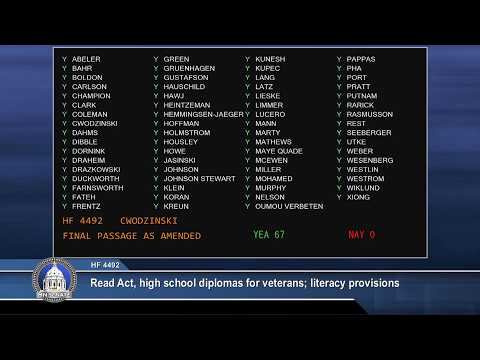
House File 4492, amended by an A4 delete-and-insert, passed the Senate 67-0; the bill includes READ Act provisions, a requirement that districts and the Department of Education award high-school diplomas to eligible Korean and Vietnam veterans, and other early-literacy changes.
The Minnesota Senate on May 17 approved House File 4492, a multi-article education package that includes READ Act provisions, new guidance on early literacy and a provision allowing veterans who left high school to serve in the Korean or Vietnam wars to receive high-school diplomas from their local district.
Senator Swazinski offered and the Senate adopted an A4 amendment that replaced the bill text with three articles: a READ Act-related article (sponsored by Senator May Quade), Senator Rasmussen's veterans-diploma provision, and an amendment adopted previously in the Education Policy Committee. Senator Swazinski described the package as the final agreed policy language from the authors and highlighted article 2, which requires the Department of Education and school districts to award diplomas to veterans who dropped out to serve during the Korean or Vietnam wars.
Senator McQuade discussed REDDAC-related changes and said that, starting June 1, teacher-candidates enrolled in teacher-prep programs would receive REDDAC training within their programs rather than requiring separate training. Senator Rasmussen spoke about veterans who asked for recognition following a visit to the Fergus Falls veterans home and urged support for the diploma provision.
The secretary recorded final passage as 67 ayes and 0 nays; the bill passed and its title was agreed to.
Why it matters: the bill combines early-literacy implementation steps with a symbolic and administrative change recognizing veterans interrupted by wartime service; sponsors described the measures as bipartisan and long-sought by stakeholders.