Get Full Government Meeting Transcripts, Videos, & Alerts Forever!
Get email alerts on the Sidewalk Snow Removal topic
No spam. Unsubscribe anytime.
Bloomington council holds workshop on pedestrian access after heavy snow, considers higher fines and targeted clearing
Summary
Councilmember-led workshop explored enforcement, equipment and volunteer strategies to make sidewalks, curb ramps and bus stops passable after snow. Staff said current code requires property owners to clear sidewalks within 24 hours; council signaled interest in changing fines, piloting services and improving interdepartmental tracking.
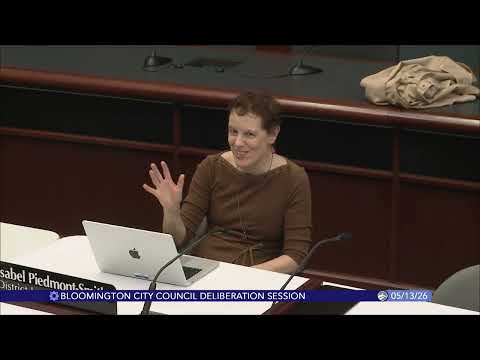
Councilmember Flaherty convened a deliberation session on May 13 to identify opportunities to improve pedestrian safety and accessibility after snow events and to set possible next steps for code, budget and operations.
“Identifying opportunities to improve pedestrian safety and accessibility following snow events” was the purpose Flaherty described as she opened the workshop and laid out a process that would move from policy review to constituent feedback, departmental input and solution brainstorming. Flaherty also said she had exported city complaint reports and noted there were "400 plus" user complaints in the sidewalk snow removal category this winter while the housing and neighborhood department’s figures reported roughly "275 complaints and 307 citations," a discrepancy she said staff would clarify.
Tim Street, Bloomington’s director of parks and recreation, described parks’ priorities and constraints and said the B‑Line and major trails receive the highest priority during snow events. "The B‑Line is sort of the champion priority of all the priorities that we have," Street said, adding that parks use a mix of pickups with blades, UTVs, snowblowers and hand shovels and that extreme storms have required front loaders to haul snow away.
Residents and council members raised repeated concerns about monolithic sidewalks (sidewalks that meet the street with no planting strip), curb ramps filled by plow pushes, and inaccessible bus stops. James Ford, a resident, urged the council to address alleys and suggested the housing department have "a coordinator of volunteers for the neighborhood" so neighbors can report and organize help. "At least think about alleys as an issue for people who are having difficulty getting around," Ford said.
Several speakers advocated changes to enforcement and fines. Zach Ammerman, a resident who said large apartment owners frequently do not clear sidewalks, urged recalibrating penalties so they are not cheaper to pay than to comply: "It should be a fine per unit," he said, adding that fines should escalate faster for multiunit properties and homeowners associations. Council members discussed options including scaling fines by linear feet or property type, extending the period before penalties reset, and charging property owners rather than tenants.
Participants discussed pilots and budget options already tested by public works, including a $50,000 pilot to clear some downtown sidewalks and curb ramps and roughly $700,000 in general equipment and material spending for snow operations. Flaherty said some pilots such as the College–Walnut corridor effort were costly and difficult to sustain, which led council members to consider targeted downtown overlays, fee‑for‑service removal that bills property owners directly, or neighborhood grants for shared tools like sidewalk-sized snowblowers.
Several council members pressed for better data and operational tracking so the city can measure capacity and outcomes. Street and others suggested GIS or CityWorks could record linear feet cleared and overtime hours to build a baseline of what the city can accomplish during different storm types. Participants also raised leveraging parking enforcement officers, parking meter conversion and proactive monitoring of high‑priority pedestrian routes as ways to increase coverage.
No formal motions or votes were taken. Flaherty said she will follow up with department heads, Bloomington Transit and the transportation commission, and she asked interested council members to join a working group to draft code adjustments, budget requests and operational proposals for the coming winter season. The meeting adjourned with a plan for iterative work before the next budget cycle.