Get Full Government Meeting Transcripts, Videos, & Alerts Forever!
Get email alerts on the Land Use topic
No spam. Unsubscribe anytime.
Watershed chairman Thomas Becker urges board to oppose large solar easements, warns of litigation
Summary
Thomas Becker, chairman of a local watershed committee, told the Manhattan village board that proposed solar easements covering thousands of acres threaten farmland and urged the board to support a district to protect rural land; he said litigation is prepared if land‑use protections fail.
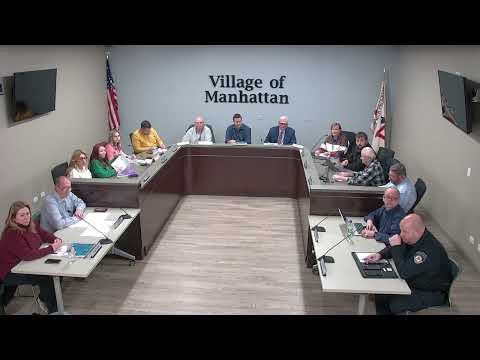
Thomas Becker, chairman of a local watershed committee, told the Manhattan village board on March 3 that residents face proposed large‑scale solar development and broad easement agreements that, he said, would industrialize rural areas.
"We are all confronted with this 6,000 acre solar facility that's being proposed," Becker said, adding that he and his group had reviewed county records showing nearly 11,000 acres of solar easement agreements in Manhattan Township. He said similar easements elsewhere total multiple square miles and warned the projects would convert rural land to industrial uses.
Becker framed several objections: he asserted that galvanic corrosion from zinc‑galvanized steel racking could leach into soils and limit future crop use, and he raised concerns about toxic materials in solar panels and battery storage. He also said a large data center is planned roughly a mile west of Manhattan and that an entity called "Earthrise" and a company Becker identified as Accelerate Infrastructure are tied to regional industrial development he opposes.
Becker said his group is pursuing a two‑pronged strategy: grassroots organizing (petitions and signs) and an incorporation plan to protect parcels as a formal district, which would require cooperation from nearby municipalities. He added that, if land‑use authority and comprehensive‑plan protections are insufficient, "we have litigation prepared with plaintiffs to challenge the laws that have set this in place."
The board did not take formal action on Becker's remarks during the meeting. Board members thanked him for speaking and encouraged follow‑up contact; Becker asked for guidance and said he would return with updates.
Reporting note: Becker's statements summarize his review of county records and his technical claims about soil contamination and long‑term land use. Those technical assertions — including the extent of galvanic corrosion and the environmental effects Becker described — were presented as his position and were not independently verified in the meeting record. The transcript records alleged acreages, planned facilities, and company names as Becker described them; the village did not offer immediate corroboration at the meeting.