Get Full Government Meeting Transcripts, Videos, & Alerts Forever!
Get email alerts on the Disaster Recovery topic
No spam. Unsubscribe anytime.
Honolulu officials estimate $50–$100 million in city losses from Kona Low storms; FEMA reimbursement may take months
Summary
City officials told the Budget Committee that early damage assessments show roughly $50–$100 million in potential operating and capital losses to City infrastructure from two Kona Low storms; administration plans to seek federal reimbursements and may request use of the Fiscal Stability Fund to front costs.
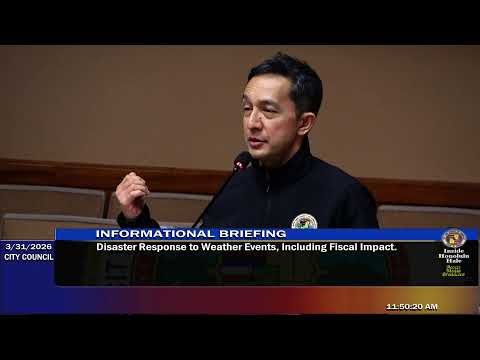
City and County of Honolulu officials told the Council's Budget Committee on March 31 that early, department-level damage assessments from consecutive Kona Low storms put the City's potential operating and capital exposure in the range of $50 million to $100 million.
"We're roughly $52 million — what we believe to be operating and CIP losses from Kona Low Storm One and Two," Managing Director Mike Formby said, urging caution because department entries duplicate in places and figures remain preliminary. Formby pointed to department-reported entries that listed about $33.3 million for Kona Low 1 and about $69.8 million for Kona Low 2 on internal damage-tracking pages, and said the City will refine those numbers as assessors verify claims.
Budget Director Andrew Kawano and Formby told the committee the administration is pursuing federal assistance, including FEMA and Federal Highway programs, which typically cover a substantial share of eligible costs. "Once we get the declaration we believe it's 75–25," Formby said, referring to a typical federal-state/local cost-share for public assistance projects; committee discussion stressed that reimbursement often comes many months — sometimes years — after expenditures are made and that the City must often front cash to be eligible.
To bridge immediate cash needs, staff said they will present the Council with options to use the Fiscal Stability Fund and other short-term measures. "We will be coming to the Council with a proposal to tap the Fiscal Stability Fund," Kawano said; Formby and Kawano emphasized the Council would determine any drawdown amount and that reimbursed federal funds should be returned to the stability fund when received.
The briefing also outlined several potential local programs and recovery steps, including a tentative $4 million business recovery grant program, coordination on farm-loss claims, and a real property tax remission process for property owners whose homes were destroyed or partially damaged (claims due by June 30, per staff). The administration reported that temporary housing options are being pursued — staff cited 61 units at Schofield as one existing source — but said details on furnishing, duration and reimbursement remain to be worked out.
Council members pressed the administration for timetables and greater detail ahead of the Council's budget deadlines in mid-April. Vice Chair Nishimoto asked for a proposal in the coming weeks that would identify how much cash is needed up front and how much can be programmed over fiscal years. Formby and Kawano said they would return with more granular line-item estimates and a recommended funding plan.
The committee received the briefing as information; no final appropriations or emergency transfers were approved during the March 31 meeting.