Get Full Government Meeting Transcripts, Videos, & Alerts Forever!
Get email alerts on the Solid Waste Recycling topic
No spam. Unsubscribe anytime.
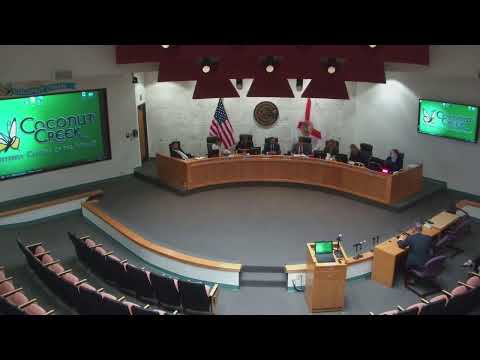
Coconut Creek commission signals support for weekly curbside recycling while staff negotiates contract language
Summary
After a multi-hour discussion, commissioners gave consensus to pursue curbside recycling with twice-weekly garbage and weekly recycling and bulk/yard service (a staff “Option 1”), and directed staff to negotiate a five-year hauling agreement with built-in annual adjustment language and contingencies tied to county Solid Waste Authority developments.
After extended presentations from city staff and Republic Services, the Coconut Creek City Commission on May 14 signaled consensus to restore curbside recycling under a phased approach and to direct the city manager to negotiate contract language with the hauler that allows annual adjustments.
Staff and Republic representatives framed the choice as a trade-off between service frequency and cost. Republic emphasized education and contamination tracking as the most important drivers of program success, saying targeted outreach can cut contamination by 20–40 percent. City staff presented a menu of price options and service-frequency scenarios for the commission to consider.
City staff presented a preliminary estimate for adding weekly curbside recycling; the presentation cited a figure of about $3.39 per month as an additional assessment but the transcript also included a conflicting reference to roughly $41 (staff acknowledged they would return with clarified numbers). City Manager and staff told commissioners they would refine the pricing and return with the exact status-quo and option-by-option numbers before any final assessment appears on a tax bill.
A central constraint in the debate was timing and disposal assumptions tied to the county Solid Waste Authority (SWA). Commissioners pressed staff and the city attorney on whether the city would be locked into long-term disposal terms if it signed a multi-year hauling contract before the SWA completes its facilities and disposal selections. City Attorney Terrell Piper and staff said the city is committed to current county disposal arrangements through July 2028 and that some contract language can identify alternate disposal locations or provide contingencies; they also noted legal limits on unilateral city withdrawal from certain interlocal amendments unless specific amendment windows are available.
Several commissioners sought a cautious, stepwise approach. Vice Mayor Brody summarized his preference as a scaled rollout: “My year 1 is number 1 — garbage twice, recycling once, bulk waste once,” and then revisit frequency and costs in year two with evaluation and education. Other commissioners urged staff to return with a clear comparison showing what a five-year “status-quo” renewal (no recycling added) would cost versus the options being discussed so the public can compare apples to apples.
Staff said they can seek consensus at the May 28 meeting on final language and noted trimming and billing deadlines (TRIM notices) that require the commission to provide a maximum assessment number in time for publication; staff said the trim submission schedule and the contract-expiration date (Sept. 30) create urgency to have a negotiated document ready to review.
The commission’s direction was nonbinding: members requested the city manager to negotiate the hauling contract consistent with the commission’s preference (Option 1) while writing flexibility into the agreement for annual adjustments and contingencies in the event SWA outcomes change. Staff agreed to return with clarified cost figures, a status-quo five-year number, and draft contract language at a subsequent meeting for formal action. The commission did not take a final vote on the hauling contract or assessments at the May 14 meeting.
Why it matters: Restoring curbside recycling affects service frequency, municipal assessments on property tax bills, and how the city disposes of recyclable material. Commissioners emphasized both resident expectations and fiscal prudence as they seek a sequence that preserves options if county-level disposal decisions change.
What’s next: Staff will refine and publish the full cost comparisons (including a five-year status-quo estimate), draft contract language to preserve annual adjustment options and alternate disposal sites, and return to the commission for formal action and an assessment that could appear on the TRIM notice if adopted.