Get Full Government Meeting Transcripts, Videos, & Alerts Forever!
Get email alerts on the Public Outreach topic
No spam. Unsubscribe anytime.
Charter Review subcommittee forms outreach team, plans survey, weekly digests and district town halls
Summary
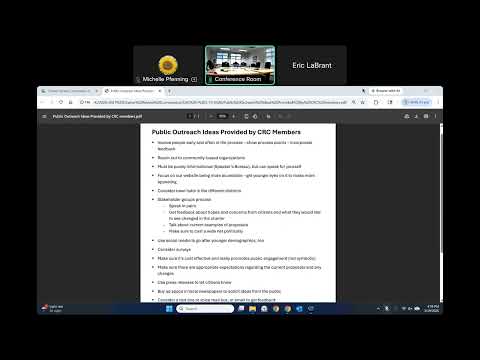
The Charter Review Commission work‑plan subcommittee on March 19 agreed to form a standing outreach committee to run a two‑phase public‑engagement plan: an immediate short survey and weekly email/press digests after second readings, followed by district town halls, a speakers bureau and website improvements.
The Charter Review Commission work‑plan subcommittee agreed on March 19 to create an outreach committee to coordinate public engagement for charter amendment proposals, setting out a two‑phase plan that begins with a short survey and moves to district‑level town halls and informational materials once ballot items are finalized.
Members said the outreach committee will be responsible for three linked tasks: producing a concise public survey immediately to capture residents’ priorities and reactions to draft proposals; issuing a weekly news or email digest highlighting items that pass second reading with links to documents and sponsor contact information; and scheduling district town halls and a speakers bureau to present consistent, non‑advocacy information to neighborhoods and community groups. Participants framed the work as informational rather than promotional, and emphasized linking to authoritative sources such as the county elections website to avoid duplicate or conflicting materials.
The group proposed a survey of four core questions to be launched right away: residents’ hopes for Clark County, their primary concerns, what changes to the charter they would prefer to address those concerns and reactions to a set of current proposal examples. Committee members debated platform and verification: county staff can host or assist with survey logistics but use of external tools (e.g., SurveyMonkey) could incur costs, and members said anonymity and open responses have tradeoffs for evidence quality.
To focus outreach, the subcommittee agreed that passage at a second reading would trigger targeted outreach: the commission would publish a weekly digest listing the items that passed second reading, link to the proposal documents and video, and invite comment via the survey or by emailing the sponsor. Members said that cadence should limit spam flags and allow timely, item‑specific feedback during the study committee period rather than overwhelming the public with all proposals at once.
Town halls would be district‑level and aim for accessible venues such as libraries, farmers markets and community festivals, with one event in each phase; members suggested May/June and a fall round near September as likely windows. The subcommittee discussed rotating commissioners for field appearances, preparing a shared slide deck and scripted talking points, and asking attendees to submit written comments or email feedback so the outreach committee can aggregate responses by topic.
Calendar constraints informed the timing discussions: members referenced the commission’s second‑reading window around May 20 and noted a draft committee deadline (cited as June 19) that shapes when subcommittees must incorporate public feedback. The outreach committee will also coordinate with county communications staff to use existing neighborhood distribution lists and the county’s PIO to circulate the weekly digest and social posts.
Participants volunteered to serve on the outreach effort and assigned near‑term tasks: one member said she would draft an outline of the outreach presentation and send it to commissioners by Monday noon for the next meeting; others offered to help with the HTML landing page and with social‑post scheduling. The subcommittee recommended the immediate formation of the outreach committee to execute the plan and agreed to present a short draft of the outreach framework at the next meeting.
The subcommittee adjourned after assigning these next steps and confirming that outreach — including a short, early survey, streamed and local town halls, weekly digests, sponsor contactability and a clean landing page — is the commission’s immediate action item.