Get Full Government Meeting Transcripts, Videos, & Alerts Forever!
Get email alerts on the Housing Code Amendments topic
No spam. Unsubscribe anytime.
San Luis Obispo Planning Commission recommends code changes on ADUs, mobile-home rent caps and homestays
Summary
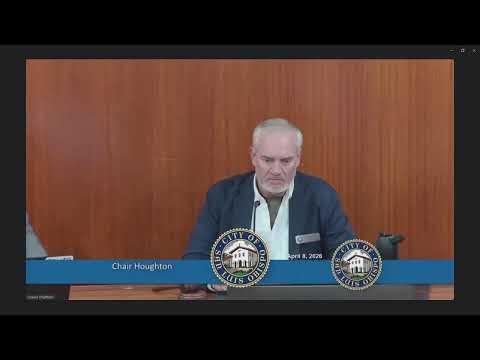
The Planning Commission voted unanimously to recommend that City Council introduce and adopt amendments to Titles 5, 16 and 17 of the municipal code removing barriers to ADU construction, aligning rules with state law, eliminating a long-term lease exemption for mobile-home rent stabilization and clarifying homestay rules.
The San Luis Obispo Planning Commission voted unanimously to adopt a resolution recommending that the City Council introduce and adopt an ordinance amending Titles 5, 16 and 17 of the municipal code to update rules on accessory dwelling units (ADUs), junior ADUs, minor urban lot splits, mobile-home rent stabilization, homestays and other housing-related regulations.
Senior Planner David Amini, of the Housing Division, presented the amendments and told the commission: "Tonight's recommendation is for the commission to adopt the draft resolution, which recommends that the City Council introduce and adopt an ordinance amending title 16, subdivision regulations, title 17, zoning regulations, and title 5, licenses, permits, and regulations of the city's municipal code regarding accessory dwelling units, junior accessory dwelling units, urban lot splits, mobile homes, and other clarifications and changes to regulations associated with housing." He said the package aims to incorporate recent state law changes, remove identified code inconsistencies, and eliminate barriers to housing development identified by staff and the public.
Key changes staff described include clarifying ADU dimensions and approvals, including side and rear setbacks (4 feet for certain detached ADUs), maximum heights (examples cited: up to 18 feet for some detached ADUs and 25 feet for attached ADUs), and a provision to defer maximum ADU heights to the underlying zone standard (which in some zones could allow up to 35 feet). Amini also said the amendments expand the ADU definition to make the difference between attached and detached ADUs explicit and "clearly articulate that the first 800 sq ft of an ADU are exempt from the lot coverage requirements per state law," with anything above that counting toward lot coverage.
The draft ordinance would prohibit minor urban lot splits on properties listed as historic resources by the city or state, or where subdivision would require demolition or alteration of a listed historic resource. Staff also proposed several cleanups and clarifications: removing a covenant agreement requirement for accessory structures (to align with state law), adding driveway-visibility limits that prohibit structures 3 feet or taller within a defined visibility zone at driveway approaches, and clarifying allowed uses in the CN zone for retail spaces of 2,000 sq ft or less.
On mobile-home rent stabilization, Amini said the amendments revise the code following state law changes that removed a long-term lease exemption; as a result, leases of 12 months or longer are now subject to space-rent caps. During discussion, commissioners asked staff about the original purpose and definition of a "long-term" lease and staff reiterated that state law removed the exemption. The transcript shows some ambiguity in the back-and-forth about whether the exemption applied to "over 12 months" or to "12 months or longer;" staff summarized that 12-month leases are now subject to the ordinance and that the municipal code contains a methodology for calculating allowable space-rent increases and a process to request higher increases with justification.
Commissioners also asked staff to clarify the city's homestay rules. Staff explained homestays are intended for owner-occupied primary residences and short-term rentals of 30 days or less; to obtain a homestay permit the owner must occupy the property (or have a local representative able to respond within about 15 minutes), and annual reporting and tax compliance are required. Staff noted homestays are distinct from vacation rentals permitted by other jurisdictions that do not require owner occupancy.
After the presentation and questions, a motion was made and seconded to adopt staff's recommendation and forward the proposed ordinance to City Council. The Planning Commission conducted a roll-call vote and the motion passed unanimously: Commissioners Cooley, Flores, Jorgensen, Khan, Muñoz-Morris and Chair Dave Haxton voted yes.
Deputy Community Development Director Tyler Corey told the commission the April 22 meeting is likely to be canceled and noted the May 13 meeting is currently scheduled to include a conditional use permit for 1020 Southwood (the YMCA) to consider 24-hour operations, which would require a CUP. The meeting was adjourned after staff announced the next regular meeting logistics.
The Planning Commission's recommendation sends the ordinance package to the City Council for introduction and consideration; the City Council retains the authority to revise or reject the proposed amendments.