Get Full Government Meeting Transcripts, Videos, & Alerts Forever!
Get email alerts on the Special Education topic
No spam. Unsubscribe anytime.
Presenter outlines how schools determine special-education eligibility after an autism diagnosis
Summary
At a Delaware Department of Education learning session, a presenter explained how a medical autism diagnosis differs from an educational eligibility determination under IDEA and Delaware rules, described MTSS school supports and outcomes, and offered practical home strategies and contact information for state resources.
A presenter at a Delaware Department of Education learning session told parents how a medical diagnosis of autism differs from an educational classification and what supports schools can offer, including the multi-tiered system of supports (MTSS) and home strategies to aid children with autism spectrum disorder (ASD).
The presenter began by defining autism using the Diagnostic and Statistical Manual of Mental Disorders (DSM‑5) as "a neurodevelopmental disorder that affects social communication and interaction" and that involves restricted, repetitive behaviors. She said autism symptoms vary widely across individuals and that prevalence of ASD diagnoses has risen over the past two decades, with historically more boys identified than girls.
The session emphasized that a medical diagnosis and an educational eligibility decision serve different purposes. "A medical diagnosis of autism can be given by a psychologist, neurologist, psychiatrist or developmental pediatrician," the presenter said, adding that clinicians use behavioral observations and DSM‑5 criteria rather than a single medical test. She contrasted that with the school’s eligibility process, which determines whether a student’s disability "adversely affects the student's educational performance" and therefore requires special-education services under the Individuals with Disabilities Education Act (IDEA) and Delaware Administrative Code (925.6.6).
School-based teams typically include the parent, teacher, school psychologist, speech therapist and other members, the presenter said, and they use interviews, observations and standardized assessments to make eligibility decisions. Possible outcomes after an eligibility review include a finding of eligibility for special education and related services or a finding of not eligible; students not eligible for special education may still receive MTSS supports and interventions.
The presenter described Delaware’s MTSS vision as a whole-child framework that pairs high-quality instruction and intervention with collaboration among parents, educators and leaders to address both academic and nonacademic needs. She said MTSS practice involves assessing the student, reviewing findings and collecting data to monitor whether progress is occurring.
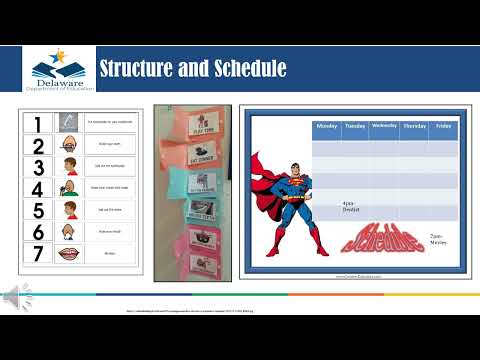
On practical home strategies, the presenter recommended using visuals (task analyses, visual schedules, first‑then boards), predictable routines, simple house rules displayed in the home, auditory or visual transition warnings (timers, countdowns), consistent reinforcement systems (praise, stickers, earned privileges) and structured choices to increase cooperation. She explained the extinction strategy as withholding reinforcement for a specific undesired behavior "while not ignoring your child as a whole," and stressed that caregivers should block or otherwise manage dangerous behaviors and seek safe alternatives.
The presenter also advised parents to identify the function of a behavior—seeking attention, access to tangibles, escape from a demand, or internal sensory stimulation—before selecting an intervention. She recommended sensory accommodations such as headphones, sunglasses or a designated calm area to filter sensory input.
The session concluded with guidance on being an informed consumer of information: consult research, major autism organizations, health and education professionals, and be cautious of social media posts that lack data. The presenter encouraged attendees to set at least one immediate action step and provided contact details for the Delaware Department of Education autism resources workgroup for follow-up and additional resources.