Get Full Government Meeting Transcripts, Videos, & Alerts Forever!
Get email alerts on the Invoice Processing topic
No spam. Unsubscribe anytime.
Greene County accounting specialist L A. Perryman outlines invoice lifecycle, timelines and checks
Summary
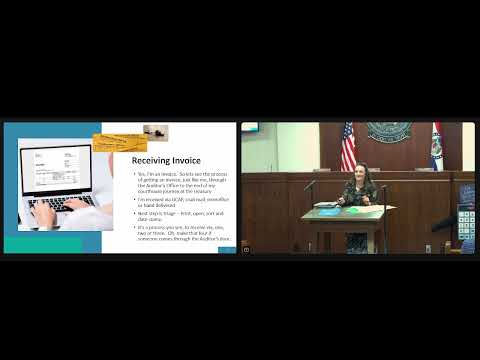
In a staff presentation, Greene County accounting specialist L A. Perryman described how invoices flow from GCAP, mail, or hand-delivery through a color-coded triage system, five layers of approval (seven people often review), and a final handoff to the Greene County Treasury; processing typically takes 10–28 days.
L A. Perryman, an accounting specialist with the Greene County Auditor's Office, walked staff through the county's invoice-processing workflow, saying vendors can generally expect payment processing to take 10 to 28 days.
Perryman framed the presentation "from the perspective of an invoice," then detailed intake channels, triage protocols and approval steps that move invoices from receipt to the Greene County Treasury. "When you submit an invoice to Greene County, you can pretty much expect it will take 10 to 28 days," Perryman said.
The auditor's office receives invoices through the county's GCAP electronic system, inner-office mail, standard mail, or hand delivery. Incoming items are triaged and placed into a color-coded folder system meant to prevent bottlenecks: blue for expedited items, green for invoices received that day, then yellow, orange and red if processing is delayed. Perryman described this as a daily prioritization routine used to ensure urgent, high-value or time-sensitive invoices are processed first.
Before approval, staff verify invoice details (invoice number, date, vendor number, account code, approval keys) and check whether the invoice matches an existing purchase order. "If it already has a PO, it's gone through an approval process," Perryman said, noting that properly coded invoices save downstream staff hours.
Perryman said invoices typically pass through five approvers and then two more reviewers at the auditor's office — "seven people look at this entry before it gets paid" — which she described as built-in accountability to reduce the risk of improper payments. After approvals, invoices are grouped into check batches (expedite, AUD, payment), checks are created and the bundles are delivered to the Greene County Treasury for issuance; in some cases the Treasury holds checks for vendor pickup.
A staff member who described the handoff to Treasury summarized that approved invoices "are filed by check group" and delivered to Treasury for final processing and vendor notification.
Perryman praised colleagues by name for producing well-coded invoices — citing Jeff Basham, Rebecca, Aisha, Michelle and Rob — and emphasized cross-training so work can continue if a person is absent. She also highlighted examples of exceptions that receive special handling, such as postage invoices for the assessor's office that require multiple commissioners' signatures and are walked through the office.
Perryman described her path to the auditor's office (previous work in sales and customer service), said she values the training and benefits at Greene County, and closed the presentation by inviting questions. She also remarked: "Right now, AI cannot do my job," while acknowledging future change is possible.
No votes or formal policy actions were taken during the presentation; the session concluded with an invitation for questions and staff follow-up.