Get Full Government Meeting Transcripts, Videos, & Alerts Forever!
Get email alerts on the Municipal Budget topic
No spam. Unsubscribe anytime.
West Valley City to Hold Truth-in-Taxation Hearings on Proposed Tax Increase to Fund Firefighters
Summary
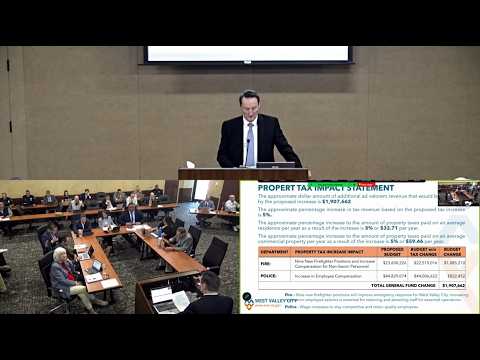
City staff presented an interim budget that includes a proposed ad valorem tax increase the council must consider; staff said the increase would raise roughly 5% in ad valorem property tax revenue and is intended primarily to fund nine firefighter positions and salary retention measures.
The West Valley City Council’s study meeting on May 12 opened with a budget presentation in which staff said the city’s interim operating budget includes a proposed property tax‑rate increase and associated property tax impact schedule, as required by Utah law. The disclosure statement read to the council referenced Utah Code section 59‑2‑294 and the council scheduled required hearings before any final adoption.
Mr. Welch, the city’s budget officer, presented the property tax impact materials and told the council the proposed rate change would increase the city’s ad valorem tax revenue by approximately 5 percent and that the additional revenue is intended to help pay for nine new firefighter positions, higher sworn‑employee salaries to improve retention, and other operating pressures including utilities and insurance. He said the city’s general operating budget presented for the council is roughly $124 million and that public safety consumes a majority of that spending.
Council members asked how staff derived the sales‑tax and population assumptions in the revenue forecast. Mr. Welch said forecasts rely on recent receipts, macroeconomic indicators (including recent inflation data) and new building permits; he noted the city’s internal population projection (discussed as about 144,000) differs from the state population committee’s published number (discussed as about 138,000), and that distributions use the committee’s official numbers and leave little room for appeal.
On schedule, staff said the council will be asked to adopt an interim (formerly tentative) budget at the May 26 meeting to authorize ongoing operations. If the council proceeds with a tax rate that exceeds the certified rate, the city will provide public notice and hold the truth‑in‑taxation hearing(s) required by Utah law before final adoption; staff said final adoption is expected in June if there is no tax increase, or in August if the council advances a property tax increase after the hearings.
Council members asked what happens if the council declines the proposed increase. Mr. Welch said that because the budget includes hiring and grant commitments, rejecting or lowering the increase would require identifying cuts or alternative revenue sources to maintain those commitments. He also said the interim budget did not earmark a specific addition to the fund balance; final fund‑balance figures depend on year‑end closing and the subsequent audit.
The council did not take a final vote on the tax rate at the study meeting. Staff directed the council to the written property tax impact schedule in the meeting packet and on the city website for exact figures; the budget officer read a figure during the presentation that is transcribed inconsistently (see city packet for the precise dollar amount). The city will publish required notices and convene the public hearing(s) before any final action by the council.