Get Full Government Meeting Transcripts, Videos, & Alerts Forever!
Get email alerts on the Fy27 Budget topic
No spam. Unsubscribe anytime.
Salem School Committee weighs FY27 budget changes including cuts to multilingual-staffing and reconfigured family engagement roles
Summary
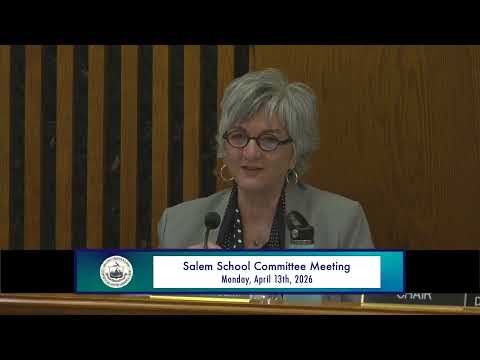
At a special April 13 meeting, the Salem School Committee reviewed proposed FY27 budget changes that would eliminate two multilingual-learner teaching positions and reduce multilingual coaching from four to one; leaders said the district will keep EL services and the newcomer academy while shifting some family engagement roles to a welcome-center model.
The Salem School Committee met April 13 to review proposed FY27 budget changes that district leaders say respond to enrollment shifts and program needs, including the proposed elimination of two multilingual-learner (ML) teacher positions and a reconfiguration of family engagement staff.
Superintendent Carboni told the committee she recognizes community concern about changes affecting multilingual learners and said the district remains “strong and unwavering” in its commitment to those students. She said ML enrollment declined by 98 students between March 1, 2024 and March 1, 2026, and that “as part of this budget, two ML teachers are being proposed to be eliminated” because of those enrollment trends. Carboni said staffing adjustments will still allow the district to maintain approximate student–teacher ratios of 25-to-1 in elementary and middle schools and that English language development services and the newcomer academy at the high school will continue.
Elizabeth, a district presenter, explained how the district calculated position-reduction impacts: of roughly 31.8 proposed position reductions, about 15.88 positions have a clear path to staying while approximately 12 positions remain in an “unknown” category because four of the reductions are current vacancies. She said if all 12 of those unknown positions are eliminated, it would equal about 1.3% of the district’s total full-time equivalents.
On multilingual coaching, district staff proposed reducing ML coaches from four to one; the remaining coach would be assigned to Bentley and Collins to support dual-language programming and an expansion to middle school. The superintendent said one coach post has been vacant this year and that the ML director will assume some administrative tasks previously handled by coaches so remaining educators can return to more direct classroom service.
On family engagement, the presenters described a shift toward a systemwide model that centralizes some functions in a welcome center. Two family engagement facilitators (FEs) would remain full-time in the welcome center; a third FE is expected to go on family leave in September and a plan was outlined to provide coverage using an FE position, paraprofessionals, or summer-program assignments. The district emphasized it will leverage existing school-level staff—adjustment counselors, City Connects coordinators, assistant principals and student success advisors—and bilingual stipendholders and contracted interpretation services to preserve family access and interpretation support.
The committee pressed for clarity on how budget snapshots were computed. Elizabeth cautioned that the per-pupil figures shown during the presentation are a rudimentary, school-level calculation that differ from the state’s official DESE per-pupil number (which the presenter said appears on DESE’s website as about $25,000). Using the district’s internal school-budget divided by that school’s enrollment produced a district-wide average of roughly $18,000 per student in the presenter’s calculations; elementary averages shown in the slides vary by school and programmatic needs. The presenter said a pilot formula for elementary non-personnel spending uses a $15,000 base plus weights for enrollment, special education enrollment, English learners, immigrant students and other program factors to allocate discretionary non-personnel funds more equitably.
Committee members raised further questions about special education staffing, noting both reductions and additions. District special-education staff said the FY27 proposal shows a net reduction in some positions (a 5.5-position reduction overall, including 2.5 at a merged school) but that the district added nine special-education positions earlier this year—seven one-to-one paraprofessionals, one teacher and one classroom paraprofessional—and that some changes (for example, replacing a social-skills teacher with a behavior specialist) respond to evolving programmatic needs.
The presentation also reviewed roughly $4.5–$5 million in recent energy upgrades (lighting, energy-management controls, weatherization, new boilers and mechanical repairs) funded through a mix of the Amoresco partnership, city capital investments and internal repairs; district staff said those upgrades are contributing to modest electricity savings though gas costs rose significantly this heating season.
The meeting included robust questioning from school committee members about timing of data (October vs. March counts), the composition of personnel costs, and alternatives to reduce impacts on vulnerable students. Member Miranda asked the superintendent to follow up with a more detailed response on how the district will demonstrate ongoing commitment to multilingual students and families.
The committee did not take a budget vote at the special meeting; discussion and follow-up steps were recorded for potential further action.
The committee moved on after the budget update to consider other agenda items including a surplus curriculum motion and a charge and membership for a superintendent screening committee.