Get Full Government Meeting Transcripts, Videos, & Alerts Forever!
Get email alerts on the Budget topic
No spam. Unsubscribe anytime.
Ashland commission debates $10M multi-year waterline plan and how to handle employee cost-of-living raises
Summary
During an extended budget work session, commissioners and staff discussed a proposed multi-year waterline replacement program (up to $10 million over ~three years), meter/collector upgrades, and competing options for employee cost-of-living adjustments—flat $1,000, 2% percent, or a hybrid—while approving 2.7% increases for pension recipients.
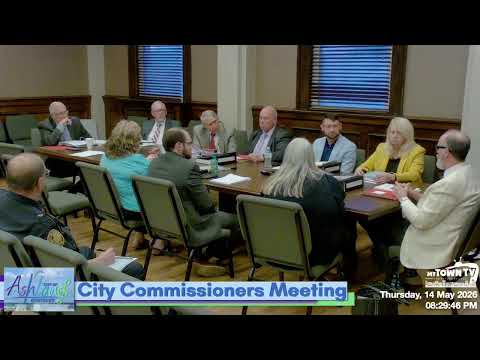
The Ashland City Commission spent substantial time May 14 in a budget work session weighing a multi-year utility capital plan and several cost-of-living adjustment (COLA) options for employees.
On utilities, staff described a prioritized, multi-year water-line replacement program developed by a water-loss team. The plan envisions a roughly $10 million investment staged over about three years to replace the city’s worst-performing lines and reduce repair costs and water loss; staff recommended beginning with engineered projects that are ready to bid. City engineering and public-works staff said prioritizing already-engineered segments lowers costs and accelerates construction. Staff also proposed investments in modern meter-reading collectors, tank repairs, hydrant replacements, and targeted repairs to pump stations and treatment equipment.
On employee compensation, commissioners debated three approaches: a flat $1,000 across-the-board adjustment, a 2% percent COLA, or a hybrid (2% with a $1,000 minimum). Commissioners and staff raised concerns about salary compression, overtime-heavy job classes (police and fire), and promotion disincentives when hourly overtime and shift structures mean field employees sometimes out-earn supervisors. One commissioner summarized the tradeoffs: the flat $1,000 is more meaningful to lower-paid workers but gives relatively larger percentage increases to higher-overtime positions; a pure percent maintains market relativity but favors higher-paid staff.
The commission did approve resolutions to apply a 2.7% COLA to members of the city’s utility pension fund and the police-and-fire pension fund, to be paid from the respective funds. Staff and commissioners scheduled a follow-up work session to finalize salary chart adjustments and the budget ordinance; they also discussed issuing utility bonds to finance the waterline program and the timing and interest-rate risk of such bonds.
Commissioners asked staff to return detailed cost estimates and the results of any further in-house or consultant pay-scale reviews before adopting a final COLA approach and before authorizing large bond issuances for capital work.