Get Full Government Meeting Transcripts, Videos, & Alerts Forever!
Get email alerts on the Mulch Yard Site Plan topic
No spam. Unsubscribe anytime.
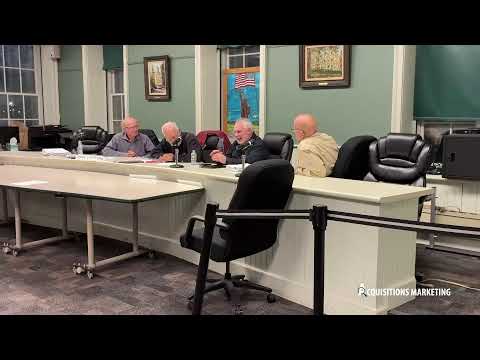
Planning board weighs amended site plan for long-running mulch yard amid green-space, sidewalk and fire-code concerns
Summary
The town’s planning board discussed an amended site plan for a longtime mulch and landscape materials yard, focusing on a requested green-space waiver (town code 30% vs applicant ~20%), sidewalk and curbcut constraints along state-owned 17M, and fire-code setbacks for mulch piles. Follow-ups were referred to building and highway departments.
The town planning board reviewed an amended site plan for a long-established mulch and landscape materials yard, emphasizing three main issues: green-space compliance, sidewalk/curb-cut constraints adjacent to the state right-of-way on 17M, and fire-code safety for seasonal mulch piles.
A board member summarized the site history, saying an earlier 2011 site plan had been approved but was never signed and now the applicant is seeking an amended plan rather than a change of use. Frank Leva, the building department supervisor, told the board the site is pre-existing and non-conforming in multiple respects (parking, storage bins, building siting) and that the front and rear parcels have effectively been merged, though public records were still catching up.
The applicant’s presenter, Jim Dylan, said he could realistically provide about 20% green space on the lot but not the 30% required under the town code. Board members noted the yard’s “fluid” green-space profile: large mulch piles are seasonal and can reduce measurable green area in peak months and open up space at other times. Sean Hoffman, the town engineer, clarified that impervious-surface requirements differ from the green-space metric and that the lot presently meets impervious-surface limits while still challenging the 30% planted/vegetated requirement.
Fire-safety was a central concern. The board cited the local reading of the New York State Fire Code and the town code: mulch piles must be set back roughly 1.5 times their height (for example, a 20-foot pile generally requires about 30–35 feet of clearance). Members discussed operational mitigations such as routine pile turning, limiting pile height or re-stacking into rows, and a follow-up meeting with the buildings department to confirm pile-management conditions.
Another recurring topic was a sidewalk waiver along 17M and Fisher Lane. Board members said the state (DOT) maintains a swale/right-of-way along 17M that effectively prohibits building or planting in that strip and makes a conventional sidewalk physically impractical in places. The planning board will request highway-department input on curb cuts and access spacing; if an off-site solution is infeasible, the board suggested a waiver or ZBA variance may be the appropriate path.
Several members compared this applicant to prior cases (nurseries, lumber yards, auto dealerships) where the planning board previously waived outdoor-storage screening requirements because the business model requires outdoor display of inventory; one member recommended the board consider reissuing a similar waiver if the display remains orderly and no public complaints exist.
Next steps: the planning board intends to refer access/curb-cut questions to the highway department, hold a buildings/fire-code follow-up meeting to confirm mulch-setback and apparatus access conditions, and determine whether a sidewalk waiver or ZBA variance is required. No final approvals were recorded during the discussion.
Why it matters: the decision balances public-safety obligations and state right-of-way limits with the operational realities of a long-running local business. The outcome will affect neighboring access, views along 17M, and how seasonal operations are measured against a fixed green-space requirement.