Get Full Government Meeting Transcripts, Videos, & Alerts Forever!
Get email alerts on the Early Literacy topic
No spam. Unsubscribe anytime.
PGCPS reports high Dibels participation and mixed midyear literacy results
Summary
Prince George's County Public Schools reported a 98% Dibels midyear completion rate (35,912 students) and four-year gains in at/above benchmark but highlighted rising interim expectations that leave many students close but not yet at benchmark. District staff said parents receive individualized reports and workshops and agreed to share a sample parent letter with the board.
Chair Jonathan Briggs convened the April 20 Academic Achievement Committee meeting and introduced district academic leaders before the committee moved to a presentation on Dibels middle-of-year screening data.
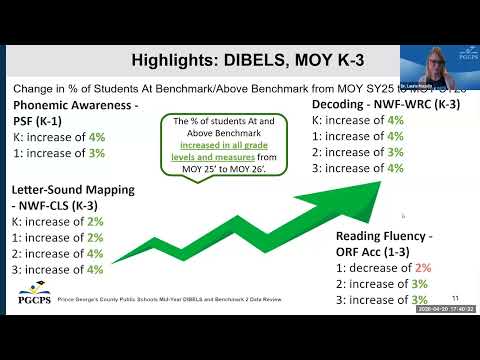
Dr. Lori Maslin, presenting the Dibels midyear report, said the universal screener had a 98% completion rate as of Feb. 18 (35,912 students) with 23 elementary schools reporting 100% completion. Maslin said four-year trends show an overall increase in students performing at or above the Dibels benchmark, but she cautioned that midyear results can show a larger 'well-below' band because the assessment's expectations rise between administrations. For example, Maslin said a kindergarten phone-name/segmentation expectation moves from five items at the beginning of the year to 29 at midyear and to 44 by year-end, which can make midyear percentages of students in the red band appear higher even when students have made classroom gains.
Maslin flagged the subset of students closest to meeting the benchmark: those within six composite points of the next performance level. She said approximately 17% of kindergarteners, 16% of first-graders, and 13% of second- and third-graders fall into this near‑benchmark band—students who may require targeted supports to cross the threshold.
Laquenta (Lquita) Reed described ongoing efforts to improve data literacy and communication. The district sends individualized monthly snapshots to principals that combine Dibels with other measures (i-Ready diagnostics, Amplify progress monitoring and Lexia usage and fidelity metrics). Reed said snapshots are intended to be actionable for school leaders and that the district offers parent workshops through vendor partners to explain assessment reports and suggest home activities.
Board members asked how Dibels results are shared with families and requested a sample copy of the parent letter. Dr. Judith White and district presenters confirmed a cover letter and parent report accompany each administration, with resources on the back of the letter and supplemental parent workshops offered; the district agreed to provide the board a sample of the letter and to check whether family‑institute sessions were recorded for broader distribution.
District presenters emphasized that Dibels is a starting point for a funnel-style data analysis that should move from system-level trends to student-level review and classroom instruction adjustments. They said schools and central offices use Dibels as part of a broader progress-monitoring system to identify students for interventions rather than treating the midyear benchmark as the only indicator.
The committee did not take formal votes on instructional changes at this meeting; presenters offered to return supplemental cohort and composite analyses requested by board members.