Get Full Government Meeting Transcripts, Videos, & Alerts Forever!
Get email alerts on the Capital Improvement Program topic
No spam. Unsubscribe anytime.
Oxnard staff outlines $1.3 billion five‑year capital plan, asks council to set public hearing
Summary
City engineer Morgan Kessler presented a draft five‑year Capital Improvement Program for fiscal years 2027–2031 covering 255 projects with an estimated five‑year cost of about $1.3 billion, and asked the Oxnard City Council to provide input, hold a public hearing, and direct staff to finalize funding allocations for partially funded projects.
Morgan Kessler, city engineer for the City of Oxnard, told the council staff has drafted a five‑year Capital Improvement Program (CIP) for fiscal years 2027–2031 that includes 255 projects with a combined estimated cost of about $1.3 billion and asked the council to provide input and schedule a public hearing on the proposal.
The draft CIP is a planning and budget‑forecasting document that separates short‑term capital budgeting from the five‑year capital program. "Presently, the CIP contains 255 projects," Kessler said, "and if you took the total value of the 255 projects over the 5 years, the CIP would have a value of about $1,300,000,000." She emphasized that routine maintenance is handled in department operating budgets and not in the CIP.
Why it matters: the CIP directs investment in major infrastructure — roads, utilities, parks, seawalls and public facilities — and competes with other city priorities for limited general fund and Measure O dollars. Kessler said the program also identifies projects that could be supported by grants, development impact fees, enterprise revenue or Quimby (park dedication) funds gathered from neighborhood input.
Staff outlined a multistep prioritization process. Projects are first grouped by type — Group S for health and safety projects (examples: water, wastewater, police and fire facilities), Group P for asset preservation (examples: road repaving), and Group E for new or expanded services (examples: new parks or building additions). Staff then refines priorities using the council's five‑year goals, grant deadlines, project urgency and staff workload. Kessler noted the capital projects team is not fully staffed and managers are handling full workloads, which constrains how many projects can proceed concurrently.
Kessler explained the CIP's funding categories, which guide when projects are advanced: Category 1 projects were approved in prior CIPs and are generally urgent and ready to proceed; Category 2 projects were also previously approved but are less urgent; Category 3 projects are newly identified with known funding sources and are recommended for higher priority than Category 2; Category 4 items are high‑priority but only partially funded or have no identified funding and are candidates for Measure O or general fund allocation; and Category 5 lists projects with no identified funding, serving as a needs inventory.
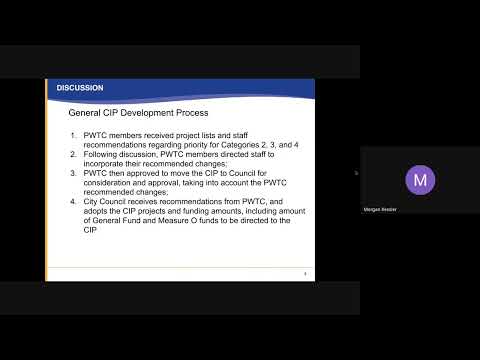
The Public Works and Transportation Committee (PWTC) reviewed the staff recommendations, made changes to Category 4 priorities and forwarded its recommendations to council for consideration. Kessler said that on the Category 4 spreadsheet attached to the staff report the first two columns show staff's original ranking and the PWTC's revised ranking for context.
Staff's explicit recommendations to council — read by Kessler — were that the council: provide input on the draft CIP and hold a public hearing on the proposed 2027–2031 City of Oxnard CIP; approve existing carryover CIP projects in the proposed funding for Category 1; reaffirm carryover projects in Category 2; approve the project prioritization lists for Categories 3 and 4; and direct staff to finalize the 2027–2031 CIP and Measure O/general fund amounts for Category 4 projects once the FY 2026–27 operating budget has been completed and CIP funding allows. Those recommendations were presented as staff requests; no formal council action or vote is recorded in the presentation.
Kessler also described constraints on financing: past litigation had limited the city's ability to issue municipal bonds (she said that lawsuit has been resolved), but the current high‑interest bond market makes borrowing less attractive. Construction prices and material costs remain elevated, and grant deadlines can impose urgency on project timing.
Neighborhood engagement: staff reported meetings with neighborhood councils about Quimby funds and included several Quimby‑funded park projects in the proposed CIP based on neighborhood requests. After council approval, staff will prepare the final CIP document (one project page per project) for public posting and internal use.
Next steps: staff will be available at the May 19 city council meeting to answer questions and the council will be asked to provide input, set a public hearing and give direction on prioritization and funding as requested by staff.