Get Full Government Meeting Transcripts, Videos, & Alerts Forever!
Get email alerts on the Public Opinion Survey topic
No spam. Unsubscribe anytime.
Council reviews 2026 National Community Survey: safety praised, confidence in government and economy lag
Summary
Polco presented results of the 2026 National Community Survey to the Dallas City Council on May 18, 2026, showing high resident ratings for safety and natural environment but declines in perceptions of government honesty and weak economic indicators; Polco offered follow-up survey options and benchmarking to similar communities.
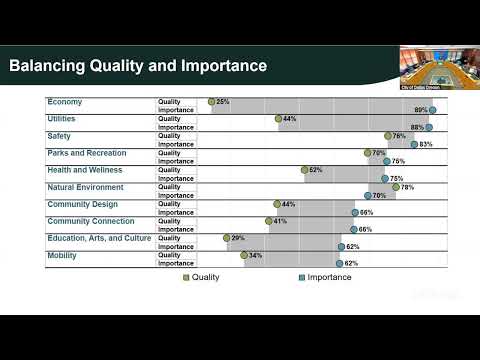
The Dallas City Council heard the results of the 2026 National Community Survey at a May 18 work session, where Polco representative Grace Arnes said residents rated safety and the natural environment strongly while ratings of government transparency and the local economy declined.
Arnes, presenting remotely from Omaha, Nebraska, said the survey used a random sample of 3,000 mailed invitations (fielding began 01/12/2026), producing 586 completed random-sample responses. "This resulted in a 21% response rate and margin of error of plus or minus 4%," she told the council, and said results were weighted to Census and American Community Survey data to reflect Dallas's adult population.
The survey reports that "about 7 in 10 residents positively rated Dallas as a place to live," Arnes said, and highlighted safety figures: "About 86% felt safe from violent crime," she reported, while roughly 84% said they felt safe from fire, flood or other natural disaster. Fire and emergency medical services received nearly 90% positive ratings; police services were rated positively by about two-thirds, a marked decline from 2023.
By contrast, Arnes said perceptions of governance had fallen since 2023. "About one-third positively rated local government for being open and transparent," she said, and several governance items scored below both the national and the city's custom benchmark comparisons. Council members said those decreases were concerning. One committee member asked, "Why are we perceived as having become less honest?" and another suggested a role for public discourse and social media in shaping perceptions.
Economic measures were among the weakest survey results, Arnes said: fewer than half of respondents positively rated the quality of local businesses and services, roughly 4 in 10 rated Dallas as a place to visit, and about 3 in 10 rated it a place to work. "About 1 in 10 positively rated employment opportunities in Dallas," she said, adding that affordability indicators (health care, food, childcare, housing) were mixed and generally lower than national benchmarks.
Councilor Barrientos questioned whether a 21% response rate could represent the whole city, asking, "So how are we to accept these numbers? Are these with just 20% of the citizens?" Arnes replied that Polco follows industry best practices and that weighting and sampling methods make the 586 responses statistically representative within the reported margin of error.
Arnes noted two benchmarking approaches: a national benchmark drawn from nearly 400 communities surveyed in the past five years and a custom benchmark comprised of roughly 30 communities in Washington and Oregon selected for comparability. She also outlined follow-up options, saying the city could run additional targeted or pre-templated surveys through Polco and use Polco's "Track" feature to compare publicly available safety and other datasets.
Council members discussed timing and communication as possible factors in the shifts: several noted the survey was fielded in January and February, a period when the council had made decisions about a police station and utility rates, and urged clearer communication about short-term successes and ongoing projects to improve public perceptions.
Polco encouraged Dallas to explore demographic cross-tabs and follow-up questions to better understand who reported which concerns and why. The council thanked Arnes and city staff (Kim Herring) for the presentation; Arnes offered to share the custom comparison list and additional analysis, and the session moved on to other business.