Get Full Government Meeting Transcripts, Videos, & Alerts Forever!
Get email alerts on the Budget Recommendation topic
No spam. Unsubscribe anytime.
Maricopa County unveils recommended FY2027 budget; CFO warns of $300 million shortfall if excise tax fails
Summary
CFO Mike McGee and Deputy Budget Director Kirsten Prindle presented the county's recommended FY2027 budget, citing conservative revenue assumptions, an $85 million operating increase, capital spending that shifted the relative share of public-safety funding, and a projected ~$300 million shortfall if the expiring excise tax is not approved by voters.
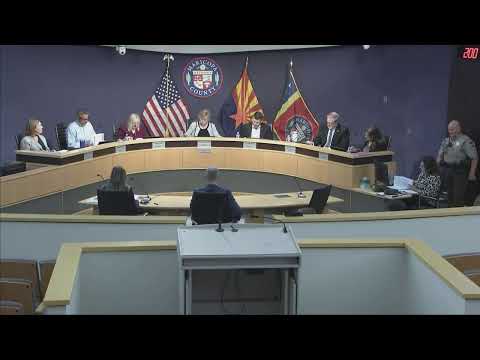
Mike McGee, Maricopa County chief financial officer, and Kirsten Prindle, deputy budget director, presented highlights of the county's recommended FY2027 budget at the May 18 Board of Supervisors informal meeting.
McGee said the recommended budget focuses on funding increased medical costs, retaining employees and meeting state-mandated payments while preserving flexibility for economic surprises. "This recommended budget focuses on funding increased medical costs, retaining employees, and satisfying state mandated payments," he said, noting the package also "invests in capital and infrastructure and reduces the overall number of positions."
McGee and Prindle described the county's conservative forecasting choices and contingencies. McGee told the board that the county's veil excise tax (a state-shared sales tax component described in the presentation) is expiring in March 2027 and will go to voters in November; "If not passed, the county faces a projected revenue shortfall of about $300,000,000," he said.
Prindle clarified budget composition and capital spending shifts. She said state-shared sales taxes are the county's largest funding source and that committed fund balances have been used largely for one-time items such as capital projects and debt payoffs. Prindle explained that a ramp-up in actual capital project spending (downtown office and elections facility, office-space optimization and debt payments) has made the capital piece a larger share of the budget, which in turn reduced public safety's percentage of the pie. "We're ramping up spending on our downtown office and elections facility," she said, noting a pending jail master plan project would reallocate capital needs.
Supervisor Galvin asked why the public-safety share fell to about 44.48 percent; McGee and Prindle said the combination of increased capital spending and pension paydown has reduced that share. Prindle emphasized that paying down pension liabilities reduced long-term employer contributions and freed one-time funds for capital projects rather than ongoing operating costs.
The presenters said the budget assumes conservative revenue growth amid higher fuel prices and international uncertainty and maintains two months of general-fund reserves following Government Finance Officers Association guidance. McGee highlighted an $85,000,000 increase in the operating budget compared with the prior year and pointed to state-mandated cost increases (7.48% in one line item) as a major driver of pressure on the budget.
The board paused the presentation to ask clarifying questions but took no formal action during this session. McGee and Prindle said more detailed materials and continued review will follow in the formal budget process.