Get Full Government Meeting Transcripts, Videos, & Alerts Forever!
Get email alerts on the Economic Development topic
No spam. Unsubscribe anytime.
La Porte council approves annexation, development deal and sale to expand Microsoft data center
Summary
After public comment and presentations on water use, noise mitigation and local payments to schools and infrastructure, the La Porte Common Council voted unanimously to approve a super-voluntary annexation, a framework infrastructure development agreement and a resolution authorizing sale of city parcels to Microsoft.
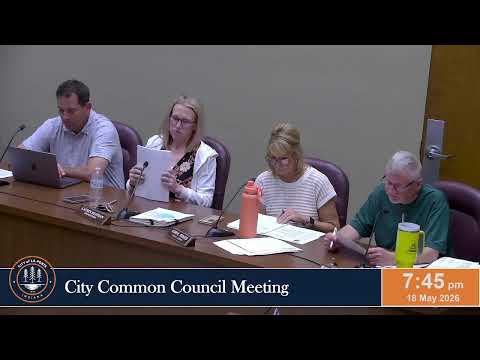
La Porte’s Common Council on May 18 approved a super-voluntary annexation and related agreements to expand the Microsoft data center campus, after nearly two hours of public comment and presentations from city staff, project consultants and utility officials.
Supporters said the project will bring jobs, infrastructure payments and a recurring revenue stream for local schools, while opponents raised concerns about noise, water, long-term corporate commitments and local control. The council approved the annexation ordinance by voice vote, then approved a framework infrastructure development agreement and a resolution authorizing the sale of two city parcels to Microsoft.
Why it matters: The development team and city leaders framed the project as a rare opportunity to increase the tax base and create construction and apprenticeship jobs. Bert Cook, executive director of the La Porte Economic Advancement Partnership, told the council Microsoft had held more than 50 meetings with local stakeholders and would pay for required municipal upgrades. "Microsoft has been a true partner all along this path," Cook said.
What was promised: Project representatives said Microsoft will fund municipal modeling and any needed system upgrades, and commit to landscaping, berms and buffers. Mike Stockwell, the project’s land-development manager, said the design will include a 300-foot "good-neighbor" buffer, native-plant screening and berming, and that Microsoft will complete acoustical and lighting studies during design. "That is our stance, and we intend to honor it," Stockwell said.
Utility assurances: Rick Kalinski, NIPSCO’s director of economic development and public affairs, told the council the utility would not shift costs to existing customers and that, based on signed agreements, customers could see credits once projects mature. "We are not raising customer rates. We have not raised customer rates," Kalinski said, adding the developer would pay generation and transmission costs associated with serving large loads.
Public concerns: Several nearby residents urged the council to require site-specific acoustic testing and binding mitigation before rezoning and annexation, saying low-frequency mechanical noise can travel and penetrate structures. Michael Johnson, who operates a home recording studio adjacent to the proposed site, said: "My livelihood depends on maintaining an extremely quiet recording environment," and asked why acoustical studies would be done only after approvals.
Opponents also questioned whether promised community benefits will be enforced. Public commenter Eric Deal cited past corporate tax disputes and urged caution, saying the operational job count does not match construction-phase employment.
Council discussion and votes: Council members expressed both hope for economic growth and the need to hold Microsoft to written commitments. The council first held a second and final reading of the annexation ordinance and then voted to approve it by voice; the motion carried. The council then introduced and approved a framework infrastructure development agreement that includes specific payments and commitments: a $200,000 contribution to the city for professional services; $3.22 per square foot toward roads/sidewalk impacts for the first building (the first building was described as roughly 300,600 sq ft); $2.60 per square foot for city essential services tied to the first building; ecological and biomimicry work on roughly 100 acres (estimated at $4,000,000); $300,000 earmarked for Travis Ditch stormwater improvements; and a $1,000,000 payment to the La Porte Community School Corporation for AI-related programming and other education efforts. City staff said local tax revenue from the project would likely begin to be seen in 2029 because Indiana collects taxes in arrears.
Property sale resolution: The council also approved a resolution authorizing the sale of two parcels to Microsoft. The resolution cited Indiana Code 36-1-11-4.2 as authority to sell property for economic development, noted that two appraisals averaged about $1,717,500, and stated Microsoft agreed to pay $145,000 per acre for an estimated 119.5 acres (a total listed in the resolution text of $17,327,500). The resolution directed the mayor to execute closing documents.
Next steps and other business: A separate rezoning ordinance for a parcel already inside city limits will return to the council at the June 1 meeting. The meeting also included a package of budget and administrative resolutions — additional appropriations for several grant and capital funds, election to join the Public Employees' Retirement Fund, and internal budget transfers — all approved by the council. The meeting adjourned following brief procedural items.
Votes at a glance: The council recorded unanimous 'aye' votes on the annexation ordinance, the framework infrastructure development agreement and the property-sale resolution during the May 18 meeting.
What remains open: Opponents’ requests for binding, pre-approval site-specific acoustical studies and a formal enforcement mechanism for Microsoft’s commitments were made on the record and remain points residents and some council members said they will continue to monitor as project design and permitting proceed.
The council is expected to consider the zoning map amendment pertaining to one city parcel on June 1.