Get Full Government Meeting Transcripts, Videos, & Alerts Forever!
Get email alerts on the Growth And Public Safety topic
No spam. Unsubscribe anytime.
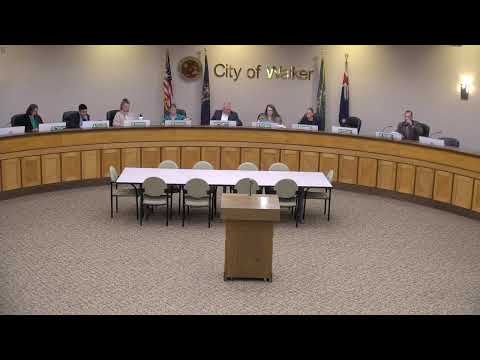
High‑school student presses Walker commissioners on growth, public safety and Wilson Avenue congestion
Summary
During a student Q&A, a high‑school student asked the Walker City Commission how the city plans to keep police and fire services, roads and traffic safety ahead of rapid growth; commissioners described recent changes to firefighting staffing and engineering reviews for Wilson Avenue.
A high‑school student who identified himself as Brandon (speaker S4) pressed the Walker City Commission on May 18 about how the city will maintain public safety and infrastructure as Walker grows, and specifically raised safety and congestion concerns along Wilson Avenue.
The student asked whether Walker’s police and fire services are expanding quickly enough to keep pace with development and how the commission prioritizes spending. Commissioners responded that the city moved firefighting to 24/7 operations in October, that it operates three stations across the city and that leadership is reviewing apparatus and staffing needs after the recent passing of the fire chief. “We went to 24 7 for firefighting,” one commissioner (S5) said, and emphasized ongoing work to balance apparatus use and training.
On Wilson Avenue congestion and safety, a newer commissioner (speaker S9), who lives on Richmond, said the corridor is controlled by MDOT and that city engineers and outside consultants have been studying intersection improvements. S9 said a left‑turn lane on Richmond was one option under review but cautioned the work could affect nearby front yards and neighborhoods; an MDOT representative (Jason Cole) routinely participates in the city’s traffic committee, a commissioner noted.
The mayor divided the student’s questions into two buckets—public safety and Wilson Avenue—and invited staff and commissioners to provide details. Commissioners also highlighted community outreach, police visibility in schools and events, and the need to monitor standards that change over time.
Other municipal updates raised earlier in the meeting included the clerk’s report of an uptick in solicitor complaints, details of the solicitor licensing process (badges, background checks and police sign‑off) and announcements about absentee ballot training and an election intern starting next week.
The commission invited students to ask follow‑up questions after the formal portion of the meeting and pointed them to traffic committee minutes for more detail on engineering studies. The meeting proceeded to regular agenda items afterward.