Get Full Government Meeting Transcripts, Videos, & Alerts Forever!
Get email alerts on the Child Welfare topic
No spam. Unsubscribe anytime.
Foster parent Ally Markwell tells Michigan oversight subcommittee CPS, CMH failed to secure residential care for her son
Summary
At a House oversight hearing, licensed foster parent Ally Markwell testified that community mental health agencies blocked residential-treatment funding, forcing her son to receive care out of state and imposing large financial and emotional costs on her family; she urged independent oversight of CMHs.
Ally Markwell, a licensed foster parent and family success coach with Fostering Forward Michigan, told the Michigan House oversight subcommittee on child welfare that community mental health agencies (CMHs) and parts of the child welfare system failed to secure residential treatment for her son and punished families who sought care outside CMH networks.
Markwell described multiple psychiatric hospitalizations, repeated emergency responses and a maltreatment-and-care investigation that was returned unsubstantiated. "When families who are fostering some of the highest needs kids in the state are not getting the support that they need, Michigan has failed," she said. She told lawmakers she and her husband spent $3,000 to hire an attorney to protect their family during the investigation and that the family now pays for private residential treatment out of state.
The testimony outlined a sequence of events Markwell said culminated when CMH staff opposed and undermined her family's application for residential-treatment funding through the Adoption Guardian Assistance Office. "CMH walked in the room and tanked our application," Markwell said, asserting their voice in the funding meeting outweighed four other qualified professionals who recommended residential care. As a result, she said, her son was placed at a facility in Ohio near Pittsburgh more than 300 miles away; the family reports round-trip visits cost about $1,500 each and ongoing private-duty nursing and travel expenses.
Markwell cited an MDHHS report stating 152 children were placed in out-of-state facilities through Michigan's Direct Care Placement Program and said the state has spent about $13,000,000 on those placements. She also said a survey she referenced found 83% of parents who sought mental-health treatment for a child in crisis experienced "significant consequences" such as investigations, licensing evaluations or threats of removal.
Representative McDonald questioned whether restraint policies and limits on containment in facilities contributed to unsafe outcomes. Markwell replied that her family uses strategic containment at home rather than formal restraints and said CMHs often refuse to refer outside their own services. She urged stronger independent review and more funding for oversight bodies, saying BCHIPS provided useful independent clinical review in her case and that Fostering Forward Michigan helped secure an expedited BCHIPS meeting.
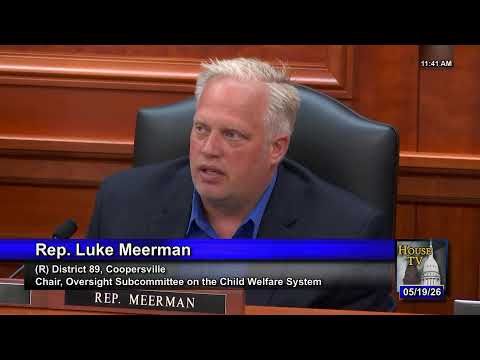
Chair Meerman and other members of the panel noted a decline in residential capacity for minors, saying the committee had lost more than 100 residential beds in the last year and that foster-parent losses are acute; one comment cited a roughly 40% decline in foster-parent numbers. Meerman said testimony like Markwell's helps illuminate systemic problems and could inform legislative reform.
The committee took two routine actions: Representative Regas moved to approve the minutes of the May 12 meeting, and the motion was approved without objection; Representative McDonald moved to excuse absent members, which also prevailed. The committee adjourned with members saying they would continue work on CMH oversight and foster-care issues.
This account is based on testimony and exchanges at the House oversight subcommittee hearing; where specific figures or study details were cited by the witness (for example, the 83% survey result, 152 out-of-state placements and the $13,000,000 figure), the article reports those as described in testimony and the MDHHS report cited during the hearing.