Get Full Government Meeting Transcripts, Videos, & Alerts Forever!
Get email alerts on the Budget topic
No spam. Unsubscribe anytime.
East Stroudsburg board moves proposed $213.1M budget forward with 5% Act 1 index recommendation
Summary
The school board voted to place a proposed $213,070,700 2026–27 budget for public advertisement; administrators say a 5% Act 1 index real-estate tax increase and state supplements are needed to close a multi‑million-dollar shortfall, while community members asked for clearer accounting of net savings from staffing changes.
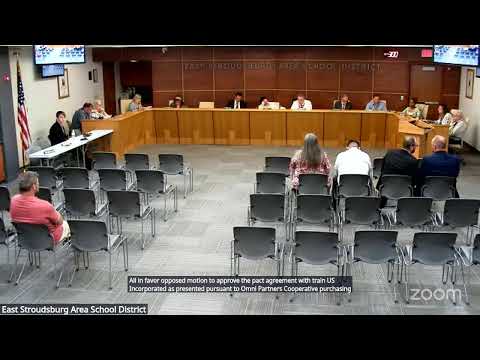
The East Stroudsburg Area School District board voted May 18 to advance a proposed $213,070,700 final budget for the 2026–27 fiscal year to public advertisement, with administration recommending the district apply the Act 1 index (a 5% real-estate tax increase) to reduce a projected operating deficit.
Director of fiscal affairs Matthew Prowse told the board the proposal reflects $197,529,785 in projected revenues against $213,070,700 in expenditures — a gap the administration estimates at $15,540,914. Prowse said two principal revenue drivers are a deferred state tax-equity supplement and an Act 1 index real-estate tax increase that could yield about $4.9 million if adopted. “This budget is an opportunity to bring the mission statement of the district to life by providing the financial resources necessary to enact the district’s vision,” Prowse said in the presentation.
Why it matters: district officials said 2 years of one-time federal stimulus funds and pandemic-era supplements have left the operating picture more vulnerable; at the same time, the district faces rising health‑care costs and one-time retirement-incentive payouts that widen near‑term expenditures.
Details: staff presentations showed the recommended millage changes would raise Monroe County’s millage to 33.01 mills (a median‑assessed homeowner impact the presentation estimated at about $278.60 annually) and Pike County’s millage to 138.62 mills (estimated at about $281.24 annually). Board members asked staff to double‑check the household math before final adoption; administration agreed to verify the calculations ahead of the June 15 final vote.
Cost drivers and offsets: administrators described a multi‑year staffing review that includes position renaming, internal promotions, consolidation of supervisory roles, a voluntary retirement incentive and other changes they say have produced savings elsewhere. At the same time, the budget includes increased district contributions to a self‑funded health trust; presenters told the board the trust’s reserves have declined to roughly 1.4–1.5 months of expected claims and that actuary-recommended funding increases are needed to stabilize reserves.
Public reaction: several community members pressed for clearer accounting of net savings. “When you follow the numbers, many of those claims don’t add up,” said resident and parent Lauren Langdon, who asked the board to reconcile consulting costs, retirement incentives and newly created positions to show net savings to taxpayers.
What’s next: the board’s motion moves the proposed final budget to the public‑advertisement stage required by Pennsylvania law; administration will continue refining the document and return on June 15 for final adoption. The board also approved several consent and capital items on May 18, including a Train US Inc. capital contract recommended by the properties committee, which administrators said will be funded from restricted capital dollars and not the operating budget.
Provenance: reporting for this article is based on the boardroom budget presentation and vote (transcript segments beginning with SEG 2003 and continuing through SEG 2490 and the roll-call exchange at SEG 4058–SEG 4326).